







Features:
-
Category:
-
Posted at:
-
Author:
- Stephanie Hesters
-
BAUNAT Antwerp
-


-
Reading time:7 minutes
In this article:
Printing Brilliance: The 3D Revolution in Jewelry Creation
From enticing millegrain rings and jewellery influenced by nature's wonders to the elusive engagement ring of your dreams, all designed in the best quality silver, gold, platinum, or titanium. The growth in demand for exclusive, bespoke jewellery aligns perfectly with BAUNAT's smart investment strategy, and one novel solution comes in the form of pioneering 3D printers. Even the most intricate jewellery designs or creative artworks, which were once a hurdle for even the most seasoned jewellers, can now be realized with ease, thanks to this groundbreaking technology.
Diamond prices evolution and market trends, as observed by Industry Expert BAUNAT, reveal one area where this innovation appears to stumble in the global trade.
Read summary
How is 3D printing transforming the jewelry industry?
3D printing technology is revolutionizing jewelry creation by making even the most intricate designs possible. While traditional craftsmanship remains dominant, this innovation allows for custom, one-of-a-kind pieces that were once challenging for experienced jewelers to produce. The technology enables hollow designs that are lighter and more resource-efficient, with processes like Direct Metal Laser Sintering creating unprecedented design possibilities.
Despite these advantages, 3D printing faces challenges in the luxury market. Many consumers associate it with mass production rather than artisanal craftsmanship, and prices remain relatively high. Some jewelry retailers have adapted by using 3D printing for prototypes rather than final pieces, creating molds filled with precious metals.
While 3D printing offers exciting possibilities for customization and innovative designs, it currently serves as a complement to, rather than replacement for, traditional jewelry manufacturing methods.
Most viewed diamond jewels
-
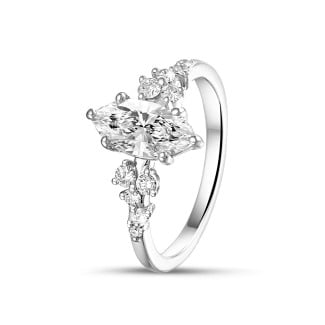
![1.00 carat solitaire cluster ring in white gold with marquise diamond]() BestsellerNew1.00 carat solitaire cluster ring in white gold with marquise diamondFrom USD 4.400,00 (excl. VAT)
BestsellerNew1.00 carat solitaire cluster ring in white gold with marquise diamondFrom USD 4.400,00 (excl. VAT) -
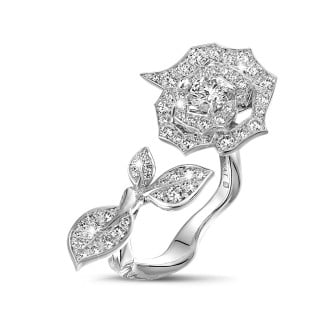
![0.95 carat diamond rose design ring in white gold]() NewPrincess Delphine0.95 carat diamond rose design ring in white goldFrom USD 16.000,00 (excl. VAT)
NewPrincess Delphine0.95 carat diamond rose design ring in white goldFrom USD 16.000,00 (excl. VAT) -
![1.00 carat solitaire ring with an asscher cut diamond in white gold]() Bestseller1.00 carat solitaire ring with an asscher cut diamond in white goldFrom USD 4.700,00 (excl. VAT)
Bestseller1.00 carat solitaire ring with an asscher cut diamond in white goldFrom USD 4.700,00 (excl. VAT) -
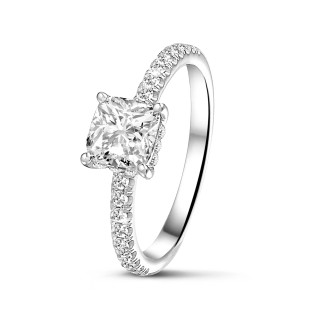
![1.00 carat solitaire ring with a cushion diamond and hidden halo in white gold]() BestsellerNew1.00 carat solitaire ring with a cushion diamond and hidden halo in white goldFrom USD 4.010,00 (excl. VAT)
BestsellerNew1.00 carat solitaire ring with a cushion diamond and hidden halo in white goldFrom USD 4.010,00 (excl. VAT) -
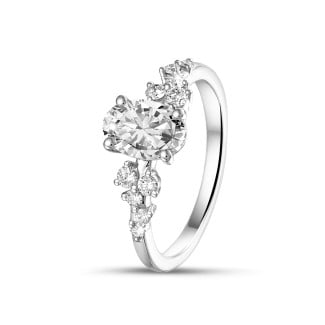
![1.00 carat solitaire cluster ring in white gold with oval diamond]() BestsellerNew1.00 carat solitaire cluster ring in white gold with oval diamondFrom USD 4.590,00 (excl. VAT)
BestsellerNew1.00 carat solitaire cluster ring in white gold with oval diamondFrom USD 4.590,00 (excl. VAT)

3D printing has a hard time in the worldwide trade
The groundbreaking technology of 3D printing, despite its potential, is yet to be widely accepted by a smart luxury consumer base. In contrast to traditional craftsmanship where each piece of jewelry is uniquely handmade, 3D printing carries an impression of mechanized bulk manufacturing. Additionally, a major deterrent continues to be the relatively inflated price of 3D-printed jewellery. Nevertheless, various online collections underscore the endless possibilities this genuinely efficient avenue offers.
3D printing seems apt for jewellery lovers yearning to conceptualize their exclusive, one-of-a-kind accessories. However, the demand is still in its nascent stages. In response, certain 3D printing enterprises have teamed up with renowned designers, supermodels, and YouTube celebrities, in a bid to create a market for 3D printed jewelry collections.
Is bespoke right for you?
Bespoke commissioning suits clients who value uniqueness and precision. Typical profiles include collectors seeking a one-off design, customers transforming an heirloom into a contemporary piece, people who need exact sizing or ergonomic adjustments, and clients who want to express personal or brand identity through jewellery. Considerations before commissioning are budget flexibility for custom work and a willingness to take part in the iterative design process. If you want a piece that reflects personal stories, exact fit and uncompromised detail, bespoke commissioning is likely the right path.
Retail chains as competitors for 3D printers
Retail chains pose as potential competitors for 3D printers. They have influenced how the technology is wielded, switching from printing finished jewellery pieces to making a prototype of the jewel instead. These prototypes are used to create moulds, which are then filled with liquid precious metal to forge the final piece. This method enables swift execution of transient trends and guarantees even the most intricate designs are achievable.
Completely new designs are now possible
A new trend is the Direct Metal Laser Sintering (DMLS) process, where a laser beam methodically eliminates layers of precious metal until a piece of jewelry is formed. EOS, a company located in Krailling near Munich, currently leads the pack in this domain. This company also extends its collaboration to the automobile, aviation, and medical industries.
Technical overview: methods, materials and finishing considerations
Additive methods commonly used in jewellery
Stereolithography (SLA) and digital light processing produce very detailed resin or wax patterns that work well for traditional lost-wax casting. Direct Metal Laser Sintering (DMLS) fuses metal powder layer by layer and can create parts with complex internal geometry without pattern-to-cast steps. Each method suits different design goals: SLA-based patterns are preferred when a cast finish and hand-setting are required, DMLS when geometry would be impractical to cast.
Materials and compatibility with gemstones
For precise stone settings many jewellers use SLA or wax-print patterns that are invested and cast in gold or platinum, keeping familiar metal properties for prongs and bezels. DMLS can make solid metal pieces but often needs more surface finishing where gemstones will be set. Delicate prong profiles and very small pavé settings are generally better executed via casting from printed patterns to reach the tolerances needed for secure stone setting.
Accuracy, tolerances and setting considerations
Modern jewellery-focused printers and CAD workflows routinely reach sub-0.1 mm accuracy in critical dimensions. That precision supports consistent stone seats and predictable fit. Allowances must be designed into prongs and bezels to account for casting shrinkage and post-processing, so collaboration between designer and setter during the CAD stage is essential.
Post-processing steps
After printing or sintering, parts undergo support removal, media tumbling or hand-polishing, and targeted filing to refine joints and setting areas. For cast pieces, sprues are removed and the metal is finished to final tolerances before stone setting. Plating, when specified, is applied only after all mechanical finishing to ensure an even, durable layer.
Realistic pros and cons
3D techniques unlock forms that were previously difficult to achieve, reduce lead time for complex prototypes and allow precise repeatability. Trade-offs include extra finishing effort to reach mirror-smooth surfaces on DMLS parts and the need to combine traditional goldsmithing skills for setting and quality control. For clients focused on the highest finish around diamonds, a CAD-to-resin-to-cast workflow often balances design freedom with proven finishing and setting techniques.
Lighter and cheaper - 3D printed jewellery
The advantage of 3D-printed jewellery includes its cost-effectiveness, lightness, and sustainable use of resources since the jewellery piece can be hollow within. However, compared to traditional products, this technique may introduce structural frailties that can compromise the durability of the jewellery piece.
The innovative application of 3D printers can bring to life special design ideas like moveable and hollow jewellery, something conventional methods can only dream of. However, the technology's prohibitive costs currently hamper its widespread adoption in mass production.
In conclusion, 3D printing adds an intriguing dimension to the jewellery enterprise, albeit not being a long-term alternative for time-honoured jewellery manufacturing.
Looking for bespoke diamond jewellery that epitomizes smart investment? Seek the personalized service of the industry expert BAUNAT in navigating the diamond market.
-
Stephanie Hesters
-
BAUNAT Antwerp
-
-
As the Head of Diamond Buying at BAUNAT, Stephanie has an extensive knowledge of the diamond and the evolution of diamond prices. Thanks to her broad product knowledge gained throughout her years at BAUNAT and the Diamond Foundation Course by De Beers, Stephanie advises our customers interested in the investment side of diamonds to optimize every investment. To support her skills she has a bachelor’s degree in Business Management together with her master’s in Communication.
About Stephanie Hesters (also known as Stephanie Lasters)
Stephanie Hesters, sometimes listed online as Stephanie Lasters, is Head of Diamond Buying at BAUNAT. She manages diamond sourcing and valuation, advises clients on market trends and pricing, and helps those looking for investment-grade stones. She completed the Diamond Foundation Course by De Beers and holds a bachelor’s degree in Business Management and a master’s in Communication.
Selected projects & collaborations
• Eternal Bloom Collection with Princess Delphine of Saxe-Coburg (2026), curator and project lead - guided creative direction and diamond selection for an exclusive collection that blends classical motifs with contemporary craftsmanship.
• Investment Diamonds Advisory Series (2024), author and presenter - developed client-facing guides and presentations on diamond valuation and market dynamics for private buyers and collectors.
• BAUNAT Editorial Features and Product Launches (2022–2025), contributor - worked with design and marketing teams to shape product narratives and ensure technical accuracy in launch materials and editorial content.
As the Head of Diamond Buying at BAUNAT, Stephanie has an extensive knowledge of the diamond and the evolution of diamond prices. Thanks to her broad product knowledge gained throughout her years at BAUNAT and the Diamond Foundation Course by De Beers, Stephanie advises our customers interested in the investment side of diamonds to optimize every investment. To support her skills she has a bachelor’s degree in Business Management together with her master’s in Communication.
About Stephanie Hesters (also known as Stephanie Lasters)
Stephanie Hesters, sometimes listed online as Stephanie Lasters, is Head of Diamond Buying at BAUNAT. She manages diamond sourcing and valuation, advises clients on market trends and pricing, and helps those looking for investment-grade stones. She completed the Diamond Foundation Course by De Beers and holds a bachelor’s degree in Business Management and a master’s in Communication.
Selected projects & collaborations
• Eternal Bloom Collection with Princess Delphine of Saxe-Coburg (2026), curator and project lead - guided creative direction and diamond selection for an exclusive collection that blends classical motifs with contemporary craftsmanship.
• Investment Diamonds Advisory Series (2024), author and presenter - developed client-facing guides and presentations on diamond valuation and market dynamics for private buyers and collectors.
• BAUNAT Editorial Features and Product Launches (2022–2025), contributor - worked with design and marketing teams to shape product narratives and ensure technical accuracy in launch materials and editorial content.