







Features:
-
Category:
-
Posted at:
-
Author:
- An Van Puyvelde
-
An Van Puyvelde - Order & Administration Manager
-


-
Reading time:14 minutes
In this article:
Adorn Your Forever Love with Ruby Engagement Ring Sets
White or colourless diamond engagement rings unequivocally take the lead when it comes to popularity. However, the merging of a vibrant coloured gemstone with a diamond can create an extraordinary, playful charm, not to be overlooked. As diamond prices evolution continues to fluctuate, the sapphire ascends as a cherished gemstone, famously embodied in Lady Di’s legendary engagement ring, now showcased by Kate Middleton. However, at BAUNAT, we believe in the power of uniqueness and invite you to consider an appealing alternative - the robust ruby, adding a fiery touch to our quality diamond rings.
Read summary
Why should you consider a ruby engagement ring as a distinctive alternative to traditional diamond rings?
Ruby engagement rings offer a captivating blend of romance and uniqueness for couples seeking something extraordinary. While white diamonds remain the classic choice, rubies - known as the "king of gems" - bring passionate red hues and symbolic meaning to engagement jewelry. These precious stones, formed from mineral corundum with chromium traces, perfectly complement diamonds in creating stunning ring designs.
BAUNAT recommends pairing rubies with white gold or platinum settings to maximize their brilliance, or yellow gold for a traditional look. However, avoid red gold settings as they can diminish the ruby's radiant appeal. When combined with white diamonds, rubies create an eye-catching contrast that makes these engagement rings truly distinctive. As diamond prices continue to evolve, ruby and diamond combinations present both a meaningful symbol of love and a smart investment choice for modern couples seeking sophisticated alternatives.

5 Questions to Find Her Perfect Engagement Ring
Are you planning to propose? Finding the right engagement ring is a defining step. Every ring is handcrafted in Antwerp from the finest materials by skilled artisans. Discover what engagement ring fits her personality.
Most viewed diamond jewels
-
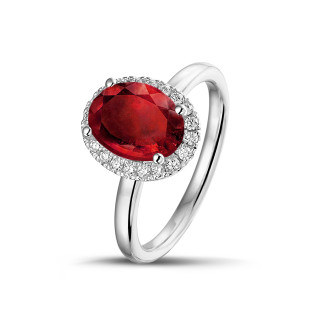
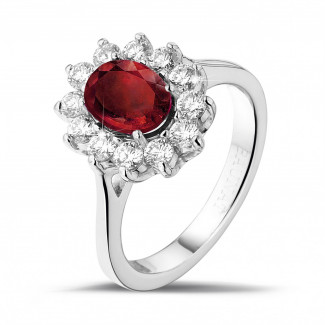
![Halo ring in white gold with an oval ruby]() Halo ring in white gold with an oval rubyFrom USD 6.770,00 (excl. VAT)
Halo ring in white gold with an oval rubyFrom USD 6.770,00 (excl. VAT) -
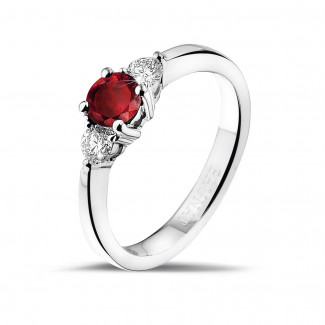
![Trilogy ring in white gold with a central ruby and 2 round diamonds]() Trilogy ring in white gold with a central ruby and 2 round diamondsFrom USD 3.500,00 (excl. VAT)
Trilogy ring in white gold with a central ruby and 2 round diamondsFrom USD 3.500,00 (excl. VAT) -
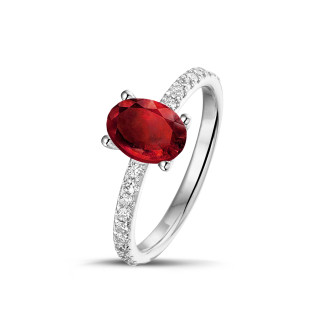
![Ring in white gold with oval ruby and side diamonds]() Ring in white gold with oval ruby and side diamondsFrom USD 6.740,00 (excl. VAT)
Ring in white gold with oval ruby and side diamondsFrom USD 6.740,00 (excl. VAT) -
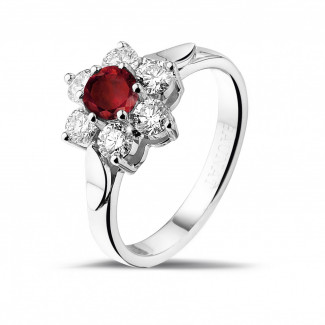
![Flower ring in white gold with a round ruby and side diamonds]() Flower ring in white gold with a round ruby and side diamondsFrom USD 4.810,00 (excl. VAT)
Flower ring in white gold with a round ruby and side diamondsFrom USD 4.810,00 (excl. VAT) -
![Entourage ring in white gold with an oval ruby and round diamonds]() Entourage ring in white gold with an oval ruby and round diamondsFrom USD 8.090,00 (excl. VAT)
Entourage ring in white gold with an oval ruby and round diamondsFrom USD 8.090,00 (excl. VAT)
...
How to Evaluate Ruby Quality: Color, Clarity, Cut and Treatments
Color
Color is the primary factor when assessing a ruby. Rubies vary from pinkish-red to deep, vivid red. The most valued tone is a pure, vibrant red with strong saturation and a medium to medium-dark tone. Trade terms such as “pigeon blood” describe an exceptional vivid red with a slight blue overtone and very strong saturation; stones with this appearance are rare and command higher prices because the hue is uncommon and visually striking. Stones that appear too dark or too brownish may lose sparkle and can look dull once set.When judging color, look at three attributes: hue (the basic shade), tone (lightness to darkness) and saturation (intensity). High-value rubies typically show a pure red hue with little secondary brown or orange, a tone that is not too light or overly dark, and strong saturation that gives the stone depth without appearing black in low light.Clarity and Cut
Natural rubies commonly contain inclusions. Unlike diamonds, almost all natural rubies show internal features - fine rutile needles, crystal inclusions or small fractures - and these are part of the stone’s character. Clarity grades for rubies differ from diamond scales; eye-clean rubies are uncommon and considerably more valuable. When judging clarity, focus on what you can see with the naked eye rather than microscopic details. Small, well-dispersed inclusions that do not affect transparency or durability are generally acceptable.Cut affects a ruby’s brilliance and how its colour reads. A balanced cut returns light while retaining colour: too shallow and the stone can look washed out, too deep and it may appear overly dark. Cushion, oval and emerald shapes are common because they keep weight while showing colour nicely. For rings that mix rubies andCommon Treatments
Many rubies on the market have been treated to improve appearance; sellers should always disclose these treatments. The main treatments to know are:- Heat treatment: The most common and widely accepted treatment. Heat can improve colour and clarity by reducing some inclusions and intensifying hue without affecting the gem’s stability. Proper disclosure is standard practice.
- Lead-glass or resin filling: Used to fill surface-reaching fissures and improve transparency. This can markedly improve appearance but may reduce durability in some situations and be more delicate with certain cleaning methods. Filled rubies must be disclosed and typically carry a value adjustment.
- Diffusion treatments: Less common for ruby than for some other gems. Diffusion adds colouring agents at high temperature to enhance surface colour. This affects only a thin layer and should be disclosed because it influences long-term value and how the stone responds to re-polishing.
Ruby Engagement Ring Styles: Which Design Suits Her?
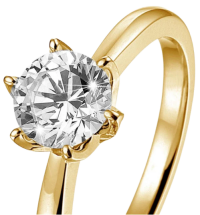
Solitaire
A solitaire places the ruby front and center on a simple band, directing attention to the stone’s colour and cut. For rubies, a balanced cut and secure prong setting are important to show depth and saturation without distraction. Because rubies keep their colour from many angles, the solitaire highlights the gem’s presence while keeping the silhouette clean. Why it works for rubies: the single-stone format avoids visual clutter, so a richly coloured ruby reads as refined rather than heavy. Prongs should be sturdy enough to protect the girdle and crown. Accent diamonds are optional and best kept minimal so they do not compete with the red centre. Recommended metals: 18Kt white gold, 18Kt yellow gold, 18Kt rose gold or platinum. Typical wearer and use case: ideal for someone who prefers timeless lines and a clear focal point; suitable for everyday wear and those who value a single meaningful stone. BAUNAT note: consider a bespoke low-profile setting to balance daily comfort with secure prongs, and pair with a plain or subtly rounded wedding band for a cohesive set.Halo
A halo frames the ruby with smaller diamonds, increasing perceived size and adding sparkle. The design can use a single row of stones for subtlety or a double halo for more presence; halo width and proportion determine whether the look leans vintage or contemporary. Why it works for rubies: white accent diamonds contrast with the red centre, enhancing brightness and making the ruby appear larger. Attention to diamond size and spacing prevents the halo from overpowering the ruby’s colour. Recommended metals: platinum or 18Kt white gold to maximise contrast; 18Kt yellow gold for a warmer look. Typical wearer and use case: suitable for those who want visible glamour, often chosen for formal styles or statement jewellery. BAUNAT note: tailor halo proportions to the ruby’s shape so the halo complements rather than overwhelms; consider a matching diamond band to echo the halo’s sparkle.Three-stone
This style places the ruby centre with two accent diamonds at the sides, balancing colour and additional brilliance. Side stones can be tapered, trapezoid or classic rounds, chosen to match the centre’s shape and weight. Why it works for rubies: side diamonds frame the centre and add light return, drawing the eye toward the ruby while providing balance. Ensure side stones are proportionate so they enhance rather than compete with the centre. Recommended metals: platinum or 18Kt gold alloys depending on desired contrast and warmth. Typical wearer and use case: suited to someone who values symbolism - past, present and future - or a symmetrical aesthetic that still lets the ruby lead. BAUNAT note: for bespoke orders, side diamond cuts can be matched to the ruby’s shape to create a seamless flow; shallow-profile shoulders improve everyday comfort.Eternity
An eternity ring has diamonds or gems set around the band; with rubies, eternity styles work well as matching wedding bands or accent rings paired with the engagement ring. Full-eternity gives constant sparkle, while half-eternity offers similar effect with easier practicality. Why it works for rubies: an eternity band with alternating diamonds and smaller rubies, or a diamond-only eternity, creates continuity when paired with a ruby engagement ring. Choice of setting affects durability. Recommended metals: platinum or 18Kt gold alloys, matched to the engagement ring metal for a unified set. Typical wearer and use case: good for those who want a coordinated stack or to mark anniversaries; a complementary wedding band option. BAUNAT note: for stacking comfort, consider channel or rub-over settings and discuss half versus full eternity to balance looks with wearability.Vintage (antique-inspired)
Vintage styles borrow motifs from historical periods - milgrain, filigree, engraving and detailed galleries - to give an heirloom feel. These settings suit rubies well, whose colour evokes classic glamour and old-world charm. Why it works for rubies: ornate metalwork provides textured contrast that brings out the ruby’s character, but the metalwork must protect the stone and allow light where needed. Some vintage details can be delicate, so reinforcement is often required. Recommended metals: 18Kt yellow gold or platinum for an authentic period look while ensuring strength. Typical wearer and use case: chosen by romantics and lovers of history or those seeking a unique, story-rich piece. BAUNAT note: custom engraving and tailored gallery work are available to echo personal motifs; reinforced prongs and protective gallery design help preserve beauty and durability.Pavé
Pavé settings embed small diamonds along the band, adding continuous sparkle that complements a central ruby without overwhelming it. Pavé can appear on the band itself or as part of a split-shank for a modern twist. Why it works for rubies: pavé highlights the central colour through surrounding sparkle, but pavé stones should be sized and set to keep visual balance with the ruby. Micro-pavé needs precise craftsmanship to ensure longevity. Recommended metals: 18Kt white gold or platinum to enhance diamond brilliance; 18Kt yellow gold for a warmer palette.Typical wearer and use case: favoured by those who want a delicate, high-sparkle look that rewards close inspection. Ruby: A Symbol of Love and a Smart Investment
Certification, Hallmarks and Provenance: What to Ask For
When investing in a ruby or a ruby-and-diamond engagement ring, paperwork matters as much as the gem itself. Proper documentation confirms what you are buying and reassures you about quality, origin and ethical sourcing.Key documents to request
- Gemstone report: For significant rubies, ask for an independent laboratory report that describes identity, weight, measurements, cut, colour descriptions and any treatments detected. Reputable labs will state whether heat treatment, filling or diffusion was found. A lab report gives objective data about the stone and is especially important for rare, untreated material.
- Metal hallmark and assay photo: Precious metal items should carry hallmarks that attest to metal fineness and origin. Request a photograph of the hallmark or a certificate confirming the metal grade. BAUNAT works with 18Kt and higher gold and can provide clear information on metal quality.
- Sales invoice with treatment disclosure: The invoice should explicitly note any enhancements and the stone’s reported status (for example, natural, heat-treated or lead-glass filled). This protects you and keeps the transaction transparent.
- Provenance and ethical sourcing statement: For buyers concerned about responsible sourcing, request a statement describing supply chain practices for the gemstone.
Quick checklist for buyers
- Request a gemological report for rubies of significant size or value. Small accent rubies may not always come with a full report, but larger centre stones should.
- Confirm metal hallmarks and ask for a photo or certificate confirming 18Kt or higher when applicable.
- Insist on written disclosure of all treatments on the invoice or accompanying documents.
- Ask about provenance and ethical sourcing; reputable sellers will be transparent about origin and supply chain practices.
Care & Maintenance
Rubies are durable gemstones and well suited for daily wear, but sensible care keeps them looking their best. For routine cleaning at home, use warm water with a mild, non-abrasive soap and a soft-bristled brush to remove dirt from under the setting. Rinse thoroughly and dry with a soft cloth.Be cautious with ultrasonic cleaners and steam cleaning when stones have been filled or heavily treated. Ultrasonic machines can worsen fractures or dislodge filler material; when in doubt, clean gently by hand and seek professional advice. Avoid exposing rubies to sudden, extreme heat or harsh chemicals which can affect some treatments and the metal setting.Setting type influences maintenance. Prong settings expose the stone and require periodic inspection to ensure prongs remain secure. Channel and bezel settings offer protection but can trap dirt in small crevices; regular cleaning or a professional polish will keep these neat.Professional services
Professional cleaning and inspection detect loose stones, worn prongs or signs of treatment issues that are not obvious to the naked eye. Ask a professional jeweller for inspection; scheduling a periodic professional check preserves both beauty and security without committing to specific timelines here.With careful daily wear and occasional professional attention, a ruby-and-diamond ring will retain its brilliance for generations.
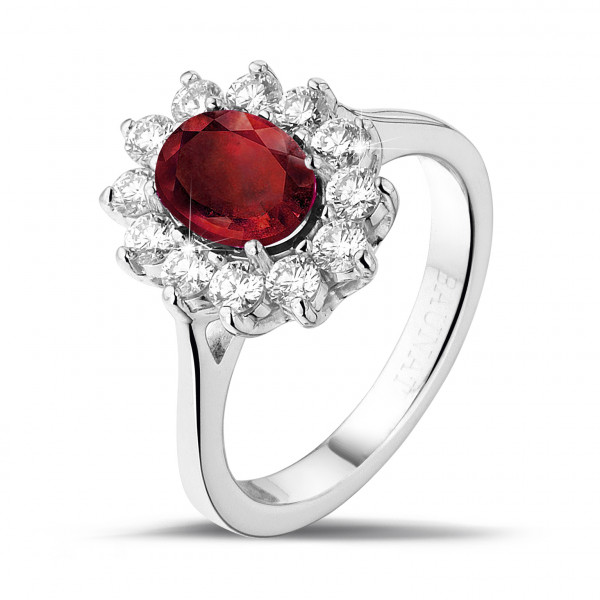
Diamond Engagement Ring with a Ruby: BAUNAT Recommendation
-
An Van Puyvelde
-
An Van Puyvelde - Order & Administration Manager
-
-
An supervises BAUNAT’s order processing and logistics, working closely with the internal order team to ensure a seamless customer experience. She plays a key role in coordinating production timelines and maintaining clear communication with clients throughout the entire process. With a strong focus on precision and reliability, An is dedicated to delivering each piece on time while keeping customers fully informed, contributing to BAUNAT’s high standard of service and customer satisfaction.
An supervises BAUNAT’s order processing and logistics, working closely with the internal order team to ensure a seamless customer experience. She plays a key role in coordinating production timelines and maintaining clear communication with clients throughout the entire process. With a strong focus on precision and reliability, An is dedicated to delivering each piece on time while keeping customers fully informed, contributing to BAUNAT’s high standard of service and customer satisfaction.