







Features:
-
Category:
-
Posted at:
-
Author:
- Stephanie Hesters
-
BAUNAT Antwerp
-


-
Reading time:18 minutes
In this article:
- Different engagement ring styles: which one do I choose?
- Diamond engagement rings, a universal love symbol
- The carat weight of the diamond
- Considerations for very large diamonds (3+ carat)
- Buying a 1-carat engagement ring: what to expect
- The colour of the diamond and the precious metal
- The clarity of the diamond
- The cut of the diamond as an indication of its brilliance
- Engagement ring trends you should be aware of
- Finding the right engagement ring size for your partner
- Custom engagement rings as a one-of-a-kind gift
- Setting up your engagement ring budget
- Engagement rings for men
- Frequently asked Questions
What to take into account when buying an engagement ring
It’s an utmost magical step in life: buying an engagement ring for the love of your life. A symbol that forever encapsulates the commitment and love shared between you and your loved one. But what exactly should you take into account when buying an engagement ring? Find out BAUNAT’s complete guide to finding your perfect piece.
Read summary
What should you consider when purchasing an engagement ring?
When buying an engagement ring, consider various styles like solitaire or halo, and choose your gemstone wisely, be it a diamond or alternatives like sapphire. Pay attention to the 4 Cs—carat, colour, clarity, and cut—to assess diamond quality. Set a realistic budget to manage costs, and ensure you know the correct ring size. Custom engagement rings and current trends, such as vintage designs, also offer unique options.
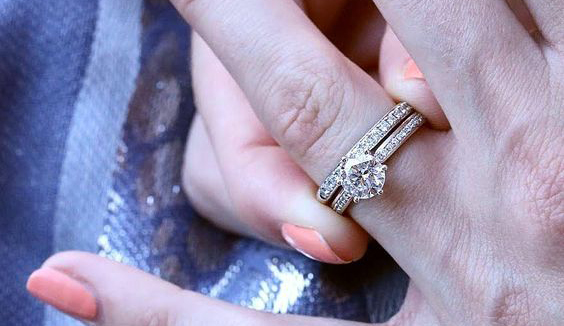
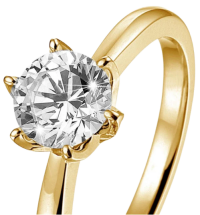
5 Questions to Find Her Perfect Engagement Ring
Are you planning to propose? Finding the right engagement ring is a defining step. Every ring is handcrafted in Antwerp from the finest materials by skilled artisans. Discover what engagement ring fits her personality.
Most viewed diamond jewels
-
![1.00 carat solitaire cluster ring in white gold with marquise diamond]() BestsellerNew1.00 carat solitaire cluster ring in white gold with marquise diamondFrom USD 4.400,00 (excl. VAT)
BestsellerNew1.00 carat solitaire cluster ring in white gold with marquise diamondFrom USD 4.400,00 (excl. VAT) -
![1.00 carat solitaire cluster ring in white gold with a round diamond]() Bestseller1.00 carat solitaire cluster ring in white gold with a round diamondFrom USD 4.130,00 (excl. VAT)
Bestseller1.00 carat solitaire cluster ring in white gold with a round diamondFrom USD 4.130,00 (excl. VAT) -
![1.00 carat solitaire ring with an asscher cut diamond in white gold]() Bestseller1.00 carat solitaire ring with an asscher cut diamond in white goldFrom USD 4.700,00 (excl. VAT)
Bestseller1.00 carat solitaire ring with an asscher cut diamond in white goldFrom USD 4.700,00 (excl. VAT) -
![1.00 carat solitaire ring with a cushion diamond and hidden halo in white gold]() BestsellerNew1.00 carat solitaire ring with a cushion diamond and hidden halo in white goldFrom USD 4.010,00 (excl. VAT)
BestsellerNew1.00 carat solitaire ring with a cushion diamond and hidden halo in white goldFrom USD 4.010,00 (excl. VAT) -
![1.00 carat solitaire cluster ring in white gold with oval diamond]() BestsellerNew1.00 carat solitaire cluster ring in white gold with oval diamondFrom USD 4.590,00 (excl. VAT)
BestsellerNew1.00 carat solitaire cluster ring in white gold with oval diamondFrom USD 4.590,00 (excl. VAT)
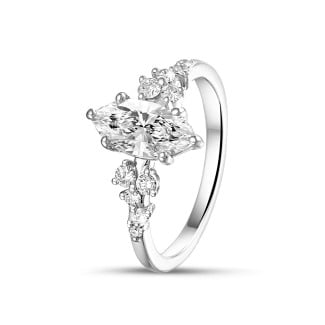


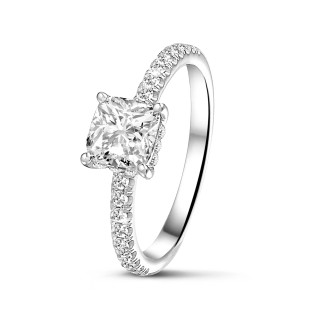
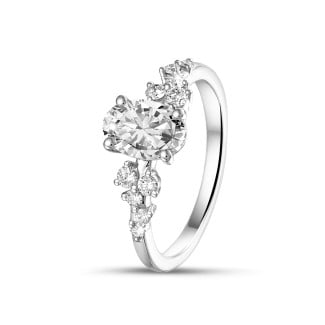
Different engagement ring styles: which one do I choose?
If you are trying to decide which engagement ring style to buy, most advice will be about solitaire rings that draw all the attention to a single diamond. However, there are plenty other options: You can have a look at the different engagement ring styles here:
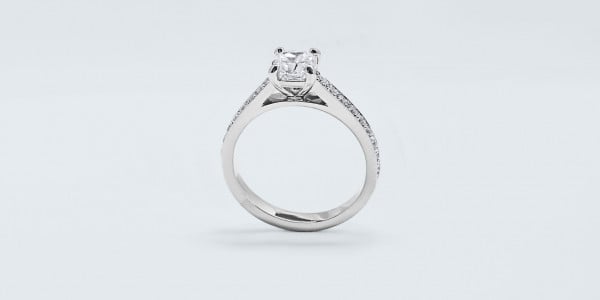
Diamond engagement rings, a universal love symbol
However, it’s important to notice that an engagement ring doesn’t necessarily have to be a diamond ring, as there are other subtler engagement rings on the rise such as sapphire, ruby, emerald, yellow diamond and black diamond rings. These other gemstones also have their beauty and are widely preferred as other worthy options.
The carat weight of the diamond
Considerations for very large diamonds (3+ carat)
Very large diamonds behave differently from smaller stones in appearance, wearability and engineering. If you are looking at a 3 carat or larger stone, keep these practical points in mind.Face-up diameter by shape: as carat weight rises, the visible millimetre diameter depends on cut and shape. Typical face-up ranges are: a 3.5 carat round sits around 9.6–10.0 mm; an oval or marquise of the same weight shows a longer, more elongated face-up and often looks larger; cushions at this weight generally measure about 9.5–9.9 mm but can appear deeper; emerald cuts usually have a smaller face-up for the same carat because of their stepped facets and greater depth. These ranges are approximate
How a large stone reads on the finger: a 3.5 carat round will attract attention on most hands, covering a substantial part of the finger top. On slender fingers the stone can look especially elegant, while on broader fingers it reads as bold and substantial. Elongated shapes such as oval, marquise and pear tend to maximise perceived surface area, so they often appear larger face-up than a round of equal weight. If you prefer a more discreet profile, stepped cuts and deeper cushions reduce apparent spread while keeping carat weight high.
Secure, wearable settings and engineering: large stones need sturdy mountings to stay secure and comfortable. For round brilliants, six prongs distribute stress more evenly and add redundancy compared with four-prong mounts. Bezel settings and low-profile baskets protect the girdle and reduce snagging, which helps with daily wear. Reinforced shoulders, thicker shanks and hidden gallery support help the setting resist deformation and keep the diamond stable. When choosing a setting, balance protection with the look you want: full bezels are very protective but give a different aesthetic than classic prongs.
Cut priority for very large stones: at this size, cut quality matters more. An excellent or ideal cut preserves brilliance and sparkle across a larger surface; poor proportions in a large stone are more visible than in smaller stones. Prioritising cut over small gains in colour or clarity usually delivers a more impressive visual result.
Price factors that move the market: prices for very large natural diamonds vary widely by shape, cut, clarity and colour,. Factors that raise a price include top colourless grades, high clarity without visible inclusions, and excellent/ideal cuts, while lower colour/clarity tiers reduce price. Rarity of a specific shape and fluorescence can also affect value.
Practical callouts
- Transport and security: large stones attract attention; consider discreet packaging, insured transit and appropriate security arrangements when collecting.
- Insurance and documentation: keep the diamond’s certificate and purchase documentation safe and arrange suitable insurance for a high-value piece.
- Resizing and long-term wear: larger settings can often be resized, but complex designs or full-eternity styles are more difficult; discuss sizing t options with your jeweller before finalising the design.
These points help ensure a very large diamond is both spectacular and suitable for daily wear.
Buying a 1-carat engagement ring: what to expect
A one-carat diamond is a classic choice because it balances presence with wearability. Below is a compact guide to what you can reasonably expect when searching for a 1.0 carat stone and ring.Typical quality tiers: prices depend on shape, cut, colour and clarity. As a practical framework, entry-level 1.0 carat stones are found in more modest colour and clarity bands; mid-tier stones prioritise a better cut and balance of colour/clarity; premium 1.0 carat diamonds combine excellent/ideal cuts with top colour and clarity grades. Use these tiers to set your budget, and compare stones on certificate details rather than on price alone.
Aftercare and service expectations: for a 1-carat ring expect routine professional cleaning,, and a clear resizing policy. Confirm that the diamond comes with a recognised certificate and that post-purchase services such as check-ups are described up front. It is also wise to obtain insurance for the ring once purchased and to keep certificate information handy for claims.
Practical quick facts
- Average ring weight and feel: a typical 1-carat solitaire feels balanced on the finger; settings with heavy side stones or thick shanks add noticeable weight.
- Common settings and their look: a classic four- or six-prong solitaire maximises face-up, a halo increases perceived size, and bezel or low-profile mounts add protection while subtly changing the ring’s silhouette.
This guidance helps you weigh price against visual impact, and understand the aftercare you should expect for a one-carat engagement ring.
The colour of the diamond and the precious metal
Instead of a colourless diamond, you can also opt for a naturally coloured diamond or a coloured precious stone. Naturally coloured diamonds are even rarer and therefore more expensive than colourless ones.
And then you also have choices in the precious metal. For an engagement ring, people often opt for white gold because it has a classic, timeless look. However, you can also opt for an engagement ring in yellow gold, platinum or even red gold. A combination of both is also possible, these engagement rings are described as ‘bicolour’ or ‘two tone’ in the collection. When combining multiple colours, you should choose a more sober design.
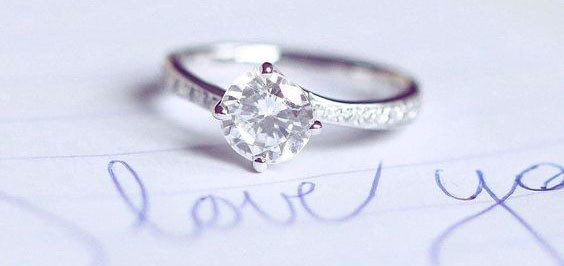
The clarity of the diamond
The cut of the diamond as an indication of its brilliance
The quality of the cut is indicated by the terms “excellent”, “very good”, “good”, “fair” and “poor”. You can always find this on the diamond certificate.
Engagement ring trends you should be aware of
Finding the right engagement ring size for your partner
You can take the ring to a jeweller for an accurate measurement or use a ring size chart at home. If that's not possible, you can sometimes find the size through friends or acquaintances. An engagement ring can however still be made bigger or smaller afterwards. At BAUNAT you can order a ring sizer for free, so you can be sure of the size without having to worry about the ring not fitting correctly.
Custom engagement rings as a one-of-a-kind gift
Choosing a custom engagement ring doesn’t necessarily mean it will be more expensive. You have the flexibility to work within your budget, making informed choices about materials and design elements. This ensures that you get the best value for your money without compromising on style or quality.