







Features:
-
Category:
-
Posted at:
-
Author:
- Stephanie Hesters
-
BAUNAT Antwerp
-


-
Reading time:13 minutes
In this article:
The famous story of the Hope Diamond
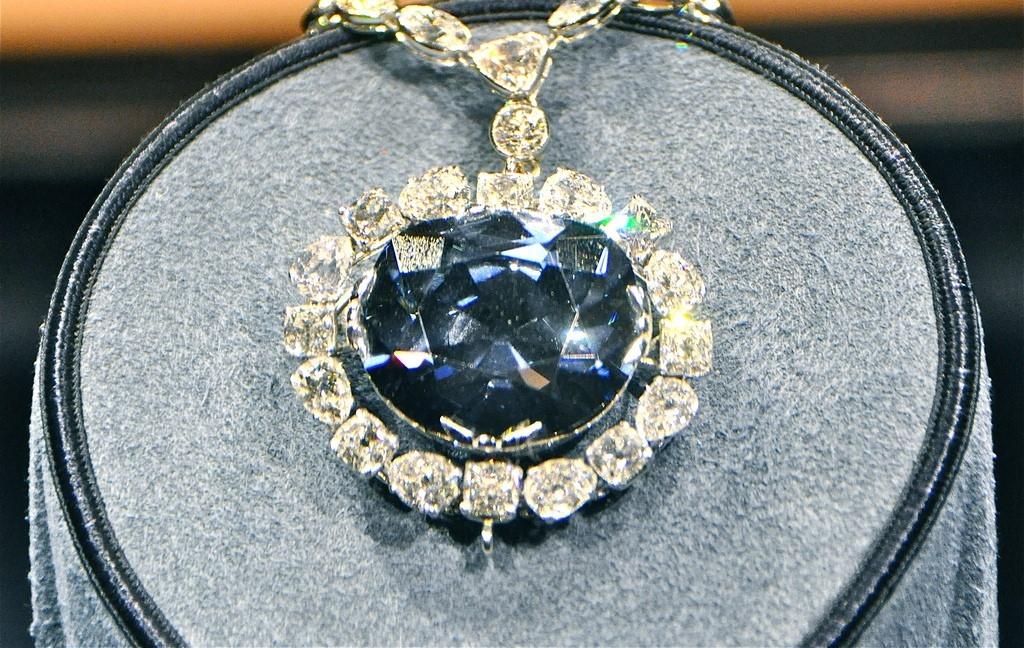
Blue diamonds are extremely rare, but you might have already heard of the most famous blue diamond of them all: The Hope Diamond. The Hope Diamond is a beautiful gemstone of 45.52 carats classed as Type IIb. This carat weight makes it the largest blue diamond ever found. The higher the carat weight, the more special and expensive the diamond becomes. Its size has also given scientists a new understanding of how diamonds are formed. The colour is described as fancy dark greyish-blue. The GIA examined the stone in 1996 and graded it a fancy deep greyish blue.
We are delighted to share the whole story with you, including the unique history that goes with the Hope Diamond.
Read summary
What's the fascinating story behind the world's most famous blue diamond?
The Hope Diamond, a spectacular 45.52-carat fancy deep greyish-blue diamond, is the largest blue diamond ever discovered and valued at approximately $350 million. This rare Type IIb diamond (part of just 0.1% of all diamonds) began its journey in India, where French merchant Jean-Baptiste Tavernier acquired a 112-carat uncut blue stone in 1660.
After being sold to King Louis XIV of France, who wore it as "Le Bleu de France," the diamond was stolen during the French Revolution. It eventually resurfaced in London, passed through several owners including Harry Winston, and was donated to the Smithsonian Institution in 1958, where it remains on display today.
The diamond allegedly carries a curse, with several owners meeting unfortunate fates. It also inspired the fictional "Heart of the Ocean" in the film Titanic. For those seeking Hope Diamond-inspired jewelry, BAUNAT offers custom-designed pieces featuring blue diamonds or more affordable sapphire alternatives.
Most viewed diamond jewels
-
![Flower Pendant with Marquise cut Blue Sapphire Petals in white gold]() Flower Pendant with Marquise cut Blue Sapphire Petals in white goldFrom USD 2.340,00 (excl. VAT)
Flower Pendant with Marquise cut Blue Sapphire Petals in white goldFrom USD 2.340,00 (excl. VAT) -
![Satellite pendant in white gold with a round sapphire]() Satellite pendant in white gold with a round sapphireFrom USD 3.520,00 (excl. VAT)
Satellite pendant in white gold with a round sapphireFrom USD 3.520,00 (excl. VAT) -
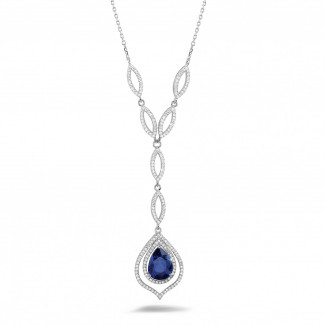
![Diamond white golden necklace with a pear shaped sapphire]() Diamond white golden necklace with a pear shaped sapphireFrom USD 24.380,00 (excl. VAT)
Diamond white golden necklace with a pear shaped sapphireFrom USD 24.380,00 (excl. VAT) -
![Entourage pendant in white gold with oval sapphire and round diamonds]() Entourage pendant in white gold with oval sapphire and round diamondsFrom USD 8.040,00 (excl. VAT)
Entourage pendant in white gold with oval sapphire and round diamondsFrom USD 8.040,00 (excl. VAT) -
![Butterfly Pendant with Marquise cut Blue Sapphire Wings in white gold]() Butterfly Pendant with Marquise cut Blue Sapphire Wings in white goldFrom USD 2.930,00 (excl. VAT)
Butterfly Pendant with Marquise cut Blue Sapphire Wings in white goldFrom USD 2.930,00 (excl. VAT)




The Hope Diamond is classified as a Type IIb diamond. Barely 0.1% of all diamonds belong to this type
Key facts and physical properties
- Carat weight: 45.52 carats (re-weighed and recorded by gemological authorities).
- Dimensions: 25.60 × 21.78 × 12.00 mm.
- Classification: Type IIb diamond. Trace amounts of boron give these stones electrical conductivity.
- Colour grade: GIA assessment - fancy deep grayish blue.
- Clarity: commonly reported as VS1.
- Cut description: antique cushion-modified brilliant, recut from the larger French Blue.
- Phosphorescence: shows strong red phosphorescence after exposure to ultraviolet light, a diagnostic trait for many natural blue diamonds.
- Notable physical detail: formed more than a billion years ago at great depth and brought near the surface by volcanic activity.
Why the diamond is blue and why the red glow matters
The blue colour comes from tiny amounts of boron in the diamond's crystal lattice. Those boron atoms absorb particular wavelengths of light, producing the gem’s blue hue. When shortwave ultraviolet light hits the stone it emits a red phosphorescence. That afterglow is useful to gemologists because the combination of boron-related absorption and the specific phosphorescence response helps confirm a natural Type IIb diamond and distinguish it from treated or synthetic blue stones.
The origin of the Hope Diamond
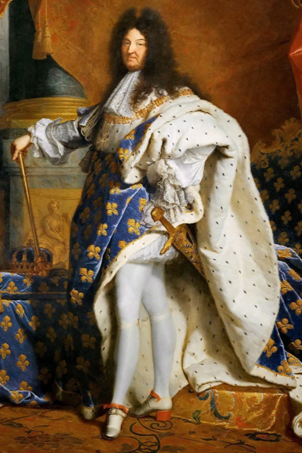
Le Bleu de France was set into a chain which Louis XIV wore on state occasions

In 1988 it was confirmed that the Hope Diamond and Le Bleu de France are one and the same
Provenance: a sourced timeline
- c. 1673: The stone was cut at the French court into the large blue gem called Le Bleu de France, worn by Louis XIV.
- 1792: During the French Revolution the French Blue was stolen from the crown jewels.
- 1812: Daniel Eliason recorded a large blue diamond in London, an early reference linking the post‑revolution stone to later specimens.
- early 1800s: The diamond, recut and reduced in size, appears in private collections and eventually becomes associated with the Hope family; Henry Philip Hope gave the stone his name.
- 1911: The gem surfaces in the United States and is acquired by prominent collectors; by the early 20th century it appears in high‑society jewels and exhibitions.
- 1911–1947: Owned by American socialite Evalyn Walsh McLean, who wore the stone mounted in an ornate necklace.
- 1949–1958: American jeweller Harry Winston acquired the diamond and, in 1958, donated it to the Smithsonian Institution’s National Museum of Natural History.
- 1962–2000s: The diamond was lent for a small number of international exhibitions, including notable loans to museums abroad and to commemorative shows.
The French Blue lead cast and the 2005 reconstruction
In the 2000s researchers found a lead cast model that matched historical descriptions of the French Blue. Computer-assisted 3D reconstructions compared the known dimensions and facet geometry of that cast with the present Hope Diamond. The reconstructions showed how the larger French Blue could have been recut into the smaller antique cushion form of the Hope, accounting for the loss of material and the addition of facets. The technical evidence from the lead model and the CAD work strengthened the link between the royal French Blue and the present Hope by demonstrating a plausible physical transformation from one stone to the other.
The mystery of the cursed Hope Diamond
Do you fancy some jewellery with a splendid blue stone like the Blue Diamond, too? Then get one made to order.
Inspiration for the Titanic’s ‘Heart of the Ocean’ jewel

How much is the Hope Diamond worth today?
What’s the Hope Diamond’s current location?
Ownership and Smithsonian accession
The Hope Diamond is part of the Smithsonian Institution’s National Museum of Natural History collection and is accessioned under specimen number 217868. Harry Winston donated the stone to the Smithsonian in 1958; famously, he sent the gem to the museum by registered mail. Since the donation the Smithsonian has kept the Hope in its gem and mineral display, removing it only for conservation work or for carefully managed loans.
Notable loans and exhibitions
Over the decades the Hope has been loaned for a handful of special exhibitions, including displays abroad and commemorative museum shows. These loans have included a major exhibition in Paris in the 1960s and other international showings, always handled under strict museum protocols.

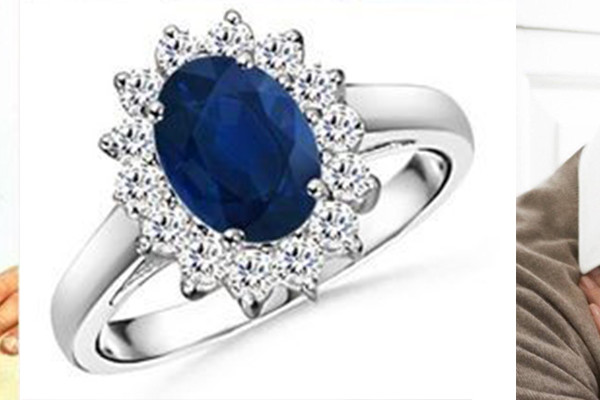
Our personal service allows you to work with our experts to design jewellery exactly as you envision it. Using our specialised software, we create a 3D model online, ensuring you are intimately involved in the development process. If you're interested in designing your own jewellery with blue diamonds, consider our tailor-made service for a hope diamond-inspired engagement ring.
Frequently asked Questions
What is a sapphire?
A sapphire is a precious gemstone and a variety of the mineral corundum. They are commonly known for their striking blue colour, though other colour variations exist as well. A sapphire is the birthstone for the month September.
How expensive is a sapphire?
All through human history,sapphires were always especially sought after because of their unique beauty. The stones decorated the robes of nobles and the crowns of kings. Sapphires are not only divinely beautiful but also quite rare. They are often used as an alternative to ultra-expensive blue diamonds, although they are also valuable themselves. The colour and size ultimately determine what is paid for a specific sapphire.
What kinds of sapphire are there?
The most beautiful sapphires of the highest quality have a superb sky-blue colour. The blue sapphire is particularly popular with the aristocracy and royalty (see the British crown jewels!), and is often gladly set in wedding jewels as an accent colour. Hence, Kate Middelton received sapphire earrings as a wedding gift from the King of Saudi Arabia. The world's most valuable sapphire is the Blue Belle of Asia with a selling price of 17 million dollars!
-
Stephanie Hesters
-
BAUNAT Antwerp
-
-
As the Head of Diamond Buying at BAUNAT, Stephanie has an extensive knowledge of the diamond and the evolution of diamond prices. Thanks to her broad product knowledge gained throughout her years at BAUNAT and the Diamond Foundation Course by De Beers, Stephanie advises our customers interested in the investment side of diamonds to optimize every investment. To support her skills she has a bachelor’s degree in Business Management together with her master’s in Communication.
About Stephanie Hesters (also known as Stephanie Lasters)
Stephanie Hesters, sometimes listed online as Stephanie Lasters, is Head of Diamond Buying at BAUNAT. She manages diamond sourcing and valuation, advises clients on market trends and pricing, and helps those looking for investment-grade stones. She completed the Diamond Foundation Course by De Beers and holds a bachelor’s degree in Business Management and a master’s in Communication.
Selected projects & collaborations
• Eternal Bloom Collection with Princess Delphine of Saxe-Coburg (2026), curator and project lead - guided creative direction and diamond selection for an exclusive collection that blends classical motifs with contemporary craftsmanship.
• Investment Diamonds Advisory Series (2024), author and presenter - developed client-facing guides and presentations on diamond valuation and market dynamics for private buyers and collectors.
• BAUNAT Editorial Features and Product Launches (2022–2025), contributor - worked with design and marketing teams to shape product narratives and ensure technical accuracy in launch materials and editorial content.
As the Head of Diamond Buying at BAUNAT, Stephanie has an extensive knowledge of the diamond and the evolution of diamond prices. Thanks to her broad product knowledge gained throughout her years at BAUNAT and the Diamond Foundation Course by De Beers, Stephanie advises our customers interested in the investment side of diamonds to optimize every investment. To support her skills she has a bachelor’s degree in Business Management together with her master’s in Communication.
About Stephanie Hesters (also known as Stephanie Lasters)
Stephanie Hesters, sometimes listed online as Stephanie Lasters, is Head of Diamond Buying at BAUNAT. She manages diamond sourcing and valuation, advises clients on market trends and pricing, and helps those looking for investment-grade stones. She completed the Diamond Foundation Course by De Beers and holds a bachelor’s degree in Business Management and a master’s in Communication.
Selected projects & collaborations
• Eternal Bloom Collection with Princess Delphine of Saxe-Coburg (2026), curator and project lead - guided creative direction and diamond selection for an exclusive collection that blends classical motifs with contemporary craftsmanship.
• Investment Diamonds Advisory Series (2024), author and presenter - developed client-facing guides and presentations on diamond valuation and market dynamics for private buyers and collectors.
• BAUNAT Editorial Features and Product Launches (2022–2025), contributor - worked with design and marketing teams to shape product narratives and ensure technical accuracy in launch materials and editorial content.