







Features:
-
Category:
-
Posted at:
-
Author:
- Stephanie Hesters
-
BAUNAT Antwerp
-


-
Reading time:15 minutes
In this article:
- Wearing a second-hand engagement ring
- Wearing your engagement on the fourth finger on the left
- Why the fourth finger? Origins and cultural variations of the 'vena amoris'
- The lost engagement ring superstition
- Dropping the ring
- How to avoid the ring-drop superstition: practical ceremony tips
- Wearing gold and silver together
- Wearing inherited rings
- Bride buying herself an engagement ring
- Is it bad luck to show the ring before the proposal?
- The gemstone of your engagement ring
- Search for the perfect engagement ring online with BAUNAT
- Frequently asked Questions
Engagement ring superstitions and myths
Engagement rings have been surrounded by numerous traditions and superstitions that have evolved over time. Zooming in on the most common superstitions, we uncover practices that range from the whimsical to the deeply meaningful. These beliefs often reflect cultural values and personal sentiments, adding an extra layer of significance to the act of giving and receiving an engagement ring.
Read summary
What are the common engagement ring superstitions and their meanings?
Engagement rings are steeped in superstitions such as wearing second-hand rings, which is considered unfortunate, and placing them on the fourth finger of the left hand, which tradition says leads directly to the heart. Losing or dropping the ring is often seen as bad omen. Gold and silver worn together and inherited rings also carry meanings. Gemstones have unique associations—diamonds show affection, sapphires and aquamarines promise happiness, while pearls are avoided for their link to tears. These beliefs enrich the cultural and personal significance of engagement rings.
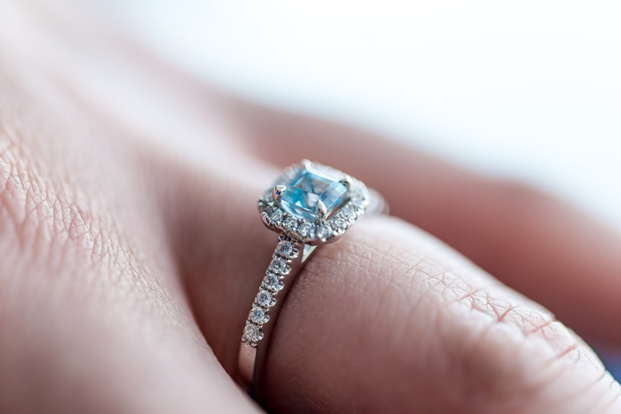
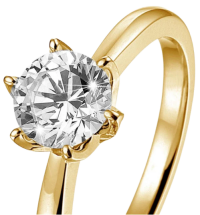
5 Questions to Find Her Perfect Engagement Ring
Are you planning to propose? Finding the right engagement ring is a defining step. Every ring is handcrafted in Antwerp from the finest materials by skilled artisans. Discover what engagement ring fits her personality.
Most viewed diamond jewels
-
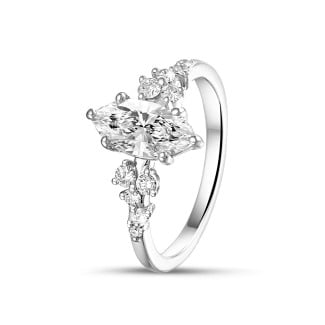
![1.00 carat solitaire cluster ring in white gold with marquise diamond]() BestsellerNew1.00 carat solitaire cluster ring in white gold with marquise diamondFrom USD 4.400,00 (excl. VAT)
BestsellerNew1.00 carat solitaire cluster ring in white gold with marquise diamondFrom USD 4.400,00 (excl. VAT) -
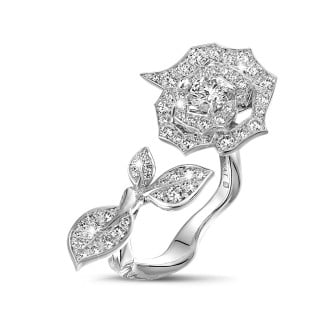
![0.95 carat diamond rose design ring in white gold]() NewPrincess Delphine0.95 carat diamond rose design ring in white goldFrom USD 16.000,00 (excl. VAT)
NewPrincess Delphine0.95 carat diamond rose design ring in white goldFrom USD 16.000,00 (excl. VAT) -
![1.00 carat solitaire ring with an asscher cut diamond in white gold]() Bestseller1.00 carat solitaire ring with an asscher cut diamond in white goldFrom USD 4.700,00 (excl. VAT)
Bestseller1.00 carat solitaire ring with an asscher cut diamond in white goldFrom USD 4.700,00 (excl. VAT) -
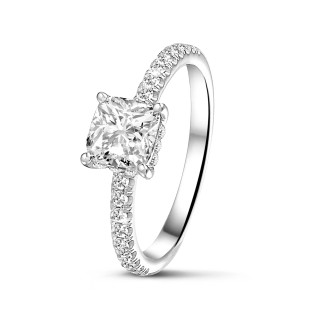
![1.00 carat solitaire ring with a cushion diamond and hidden halo in white gold]() BestsellerNew1.00 carat solitaire ring with a cushion diamond and hidden halo in white goldFrom USD 4.010,00 (excl. VAT)
BestsellerNew1.00 carat solitaire ring with a cushion diamond and hidden halo in white goldFrom USD 4.010,00 (excl. VAT) -
![1.00 carat solitaire cluster ring in white gold with oval diamond]() BestsellerNew1.00 carat solitaire cluster ring in white gold with oval diamondFrom USD 4.590,00 (excl. VAT)
BestsellerNew1.00 carat solitaire cluster ring in white gold with oval diamondFrom USD 4.590,00 (excl. VAT)

.
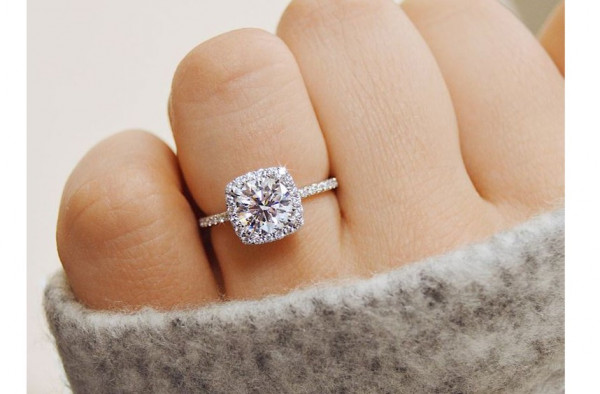
Wearing a second-hand engagement ring
Wearing your engagement on the fourth finger on the left
Why the fourth finger? Origins and cultural variations of the 'vena amoris'
Cultural practice differs notably around the world.
In much of Western Europe and the Americas the left fourth finger is conventional, tied to the vena amoris tradition and the practical convenience of wearing the ring on the non-dominant hand. In several Eastern European and Orthodox Christian countries the right hand is preferred, reflecting local liturgical customs. In parts of India and some South-East Asian communities the choice of finger can depend on regional rituals or astrological considerations rather than a single universal belief. In short, the finger chosen for an engagement or wedding band often reflects a blend of historical symbolism and local custom rather than a single ancient fact.What ring fit superstitions mean, and what to do about them
Across cultures a tight ring can be read as a sign of a close, binding relationship, while a loose ring is sometimes interpreted as uncertainty or a lack of fit. These readings are symbolic rather than diagnostic, shaped by folklore rather than medical or relational evidence. Practically, it is sensible to ensure the ring fits comfortably for daily wear and for the ceremony itself. Schedule a sizing check well before the proposal or wedding day, allow for minor swelling in warm weather, and confirm the wearer is comfortable with the chosen fit. If the couple prefers symbolism, this can inform whether they select a snug or slightly looser fit, but comfort and safety should remain the primary considerations. 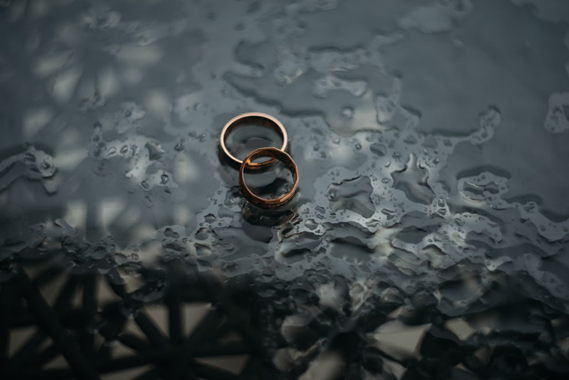
The lost engagement ring superstition
So what does it mean when your wedding ring falls off? In reality, if you ignore the superstitions, it means that your ring is too large and needs resizing. At BAUNAT, you can order a ring sizer for free before you buy to ensure this doesn’t happen.
Dropping the ring
In contrast, some modern interpretations suggest that dropping the ring allows the couple to "shake off" any bad luck, essentially starting their union on a clean slate. Regardless of its meaning, the act of dropping the ring adds a layer of drama and significance to the ceremony, reminding everyone of the fragility and value of the love being celebrated.
How to avoid the ring-drop superstition: practical ceremony tips
Checklist for rehearsals
- Designate who will hold the rings, and rehearse the hand-off. Having a single, practiced person reduces confusion and fumbles.
- Choose a ring bearer or best man for safe transport, and confirm they are comfortable with the role. A prepared holder is less likely to drop the box or ring.
- Practice the exact moment of presentation, including how the ring is passed and which hand receives it. Rehearsal reduces nervousness and awkward grips.
- Decide presentation style in advance: wrist placement, hand-to-hand, or display in a box. A consistent approach avoids last-minute improvisation.
Venue and ceremony logistics
- Avoid slippery or uneven walkways at the ceremony entrance. Stable footing lowers the chance of a stumble that could jostle a ring.
- Position the officiant and couple so there is sufficient personal space for the ring exchange. Clear space reduces accidental contact with guests.
- Close large vents or wind-prone doors near the aisle during the exchange. Gusts can surprise participants and disturb small items.
- Speak with the venue about where the rings will be stored before the ceremony; choose a secure, visible spot for the bearer. A known location prevents hurried transfers. Sizing and handling safeguards
- Keep the actual ring secured in a small, soft-lined box until the precise moment of presenting it. A box provides a stable grasp and protects the band.
- Attach a discreet ribbon loop or safety cord to the box for the bearer to wear around the wrist. A simple loop offers an extra layer of protection if something slips.
- Bring a duplicate placeholder ring for rehearsal and processional use, reserving the final piece for the exchange itself. Using a stand-in during practice preserves the actual ring until the crucial moment.
Contingency actions if a ring is lost during the ceremony
- Pause calmly and ask a few people nearby to scan the immediate area; small groups find dropped items faster than frantic searching.
- If outdoors, mark the spot where the ring was last seen and methodically search downwind and downhill from that point. A systematic search is quicker than scattered efforts.
- Have a pre-agreed plan with the officiant and photographer for a short break if needed; a composed pause keeps guests calm and prevents rushed mistakes. Practical rehearsal and ring-handling tips are commonly recommended by wedding planners. Implementing even a few of these measures will reduce the chance of a mishap while preserving the ceremony's flow and emotion.
Wearing gold and silver together
Wearing inherited rings
However, inheriting a ring also comes with its challenges. The design might not align with the bride's personal taste, or it may need resizing or refurbishing. Some couples choose to incorporate elements of the inherited ring into a new design, blending old and new to create a piece that respects tradition while reflecting their unique love story. This delicate balance between honouring history and forging a new path is a beautiful metaphor for marriage itself.
Bride buying herself an engagement ring
This shift also reflects changing economic dynamics, where both partners may feel equally responsible for major purchases. For some couples, it’s a way to ensure the ring perfectly matches the bride’s style and preferences, making the engagement even more meaningful. This trend underscores the idea that modern relationships are built on equality and mutual respect, with both partners actively participating in important decisions. Read more about buying yourself an engagement ring.
Is it bad luck to show the ring before the proposal?
Consider these benefits:
- Reduced surprise stress: knowing the ring removes the shock factor and can lead to a calmer, more considered response.
- Size and style checks: pre-viewing ensures the band and setting suit the wearer, avoiding immediate adjustments.
- Collaborative planning: sharing the ring can make the moment more personal for couples who prefer joint decisions.
- Safety and logistics: confirming the circumference and comfort ahead of time prevents last-minute sizing issues on the proposal day.
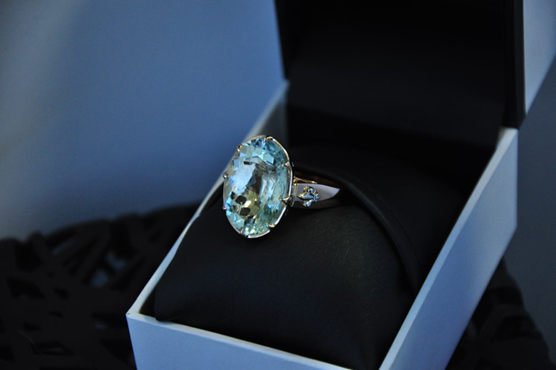
The gemstone of your engagement ring
- Wearing diamond - considered to represent affection. Diamonds are thought to be a symbol of certainty and security that comes with being in a committed relationship
- Wearing sapphire - believed to bring a happy marriage
- Wearing aquamarine - also believed to bring a long and happy marriage
- Wearing emeralds - considered to bring marital bliss, and some cultures believed emeralds have aphrodisiac properties. Natural aphrodisiacs in engagement rings may bring on sexual and intimate desires
- Wearing pearls - traditionally avoided, thought to bring tears to a marriage if used as the gemstone on an engagement ring
Search for the perfect engagement ring online with BAUNAT
Are you looking to buy an engagement ring online instead? Check out the engagement ring catalogue on the Jeweller BAUNAT website to find your perfect ring. If you have any questions, please feel free to contact our team of experts.
Interested in finding out more? Read other relevant articles from BAUNAT before you choose the engagement ring of your dreams.
Frequently asked Questions
How should I give an engagement ring?
Traditions are to be treasured, so why should you deviate from them? No woman is indifferent to a marriage proposal on one knee, especially when it happens at a special place. The place where you first met, an exotic beach, an iconic location in a world city, etc. Supply the necessary romantic accents like candles, torches, flower petals: always make sure the ambience is right. And of course a magnificent diamond engagement ring from BAUNAT! In short, do everything possible to make your proposal an unforgettable event.
What is the royal history of diamonds?
In the 13th century, an act of Saint Louis (Louis IX of France, 1214-70) established a sumptuary law that reserved diamonds for the king based on their rarity and value that was conferred to them at that time. From that moment onwards, diamonds began appearing in royal jewelry for both men and women. From the 17th century, they were also seen with the greater European aristocracy and the wealthy merchant class.
The earliest diamond-cutting industry is believed to have been positioned in Venice (Italy) somewhere around the 1330’s. It is estimated that diamond cutting found its way to Paris and Bruges around late 14th century and later to Antwerp.
By 1499, the Portuguese navigator Vasco da Gama discovered the sea route to the Orient around the Cape of Good Hope, providing Europeans an end-run around the Arabic impediment to the trade of diamonds coming from India. Goa, on India's Malabar Coast, was set up as the Portuguese trading center, and a diamond route developed from Goa to Lisbon to Antwerp.
What is the romantic history of diamonds?
The diamond is used in many pieces of exquisite jewellery and comes in various sizes. It is, however, in its smallest form that it catches our interest the most: the diamond ring given in token of love and marriage. The actual history of this tradition transcends the perception of its creation as marketing hyperbole. The modern solitaire is just the most recent step on a long road from the past.
Rings date back several millennia, but those that are given as a token of love are first noted by the comic Roman poet Plautus in the 2nd century BCE. In those times, wedding rings were known for their interior inscriptions that recorded the marriage contracts signed in the presence of the Emperor's image. This custom was continued and Christianized by the 4th century, when priests would not permit weddings anymore without the exchange of rings.
-
Stephanie Hesters
-
BAUNAT Antwerp
-
-
As the Head of Diamond Buying at BAUNAT, Stephanie has an extensive knowledge of the diamond and the evolution of diamond prices. Thanks to her broad product knowledge gained throughout her years at BAUNAT and the Diamond Foundation Course by De Beers, Stephanie advises our customers interested in the investment side of diamonds to optimize every investment. To support her skills she has a bachelor’s degree in Business Management together with her master’s in Communication.
About Stephanie Hesters (also known as Stephanie Lasters)
Stephanie Hesters, sometimes listed online as Stephanie Lasters, is Head of Diamond Buying at BAUNAT. She manages diamond sourcing and valuation, advises clients on market trends and pricing, and helps those looking for investment-grade stones. She completed the Diamond Foundation Course by De Beers and holds a bachelor’s degree in Business Management and a master’s in Communication.
Selected projects & collaborations
• Eternal Bloom Collection with Princess Delphine of Saxe-Coburg (2026), curator and project lead - guided creative direction and diamond selection for an exclusive collection that blends classical motifs with contemporary craftsmanship.
• Investment Diamonds Advisory Series (2024), author and presenter - developed client-facing guides and presentations on diamond valuation and market dynamics for private buyers and collectors.
• BAUNAT Editorial Features and Product Launches (2022–2025), contributor - worked with design and marketing teams to shape product narratives and ensure technical accuracy in launch materials and editorial content.
As the Head of Diamond Buying at BAUNAT, Stephanie has an extensive knowledge of the diamond and the evolution of diamond prices. Thanks to her broad product knowledge gained throughout her years at BAUNAT and the Diamond Foundation Course by De Beers, Stephanie advises our customers interested in the investment side of diamonds to optimize every investment. To support her skills she has a bachelor’s degree in Business Management together with her master’s in Communication.
About Stephanie Hesters (also known as Stephanie Lasters)
Stephanie Hesters, sometimes listed online as Stephanie Lasters, is Head of Diamond Buying at BAUNAT. She manages diamond sourcing and valuation, advises clients on market trends and pricing, and helps those looking for investment-grade stones. She completed the Diamond Foundation Course by De Beers and holds a bachelor’s degree in Business Management and a master’s in Communication.
Selected projects & collaborations
• Eternal Bloom Collection with Princess Delphine of Saxe-Coburg (2026), curator and project lead - guided creative direction and diamond selection for an exclusive collection that blends classical motifs with contemporary craftsmanship.
• Investment Diamonds Advisory Series (2024), author and presenter - developed client-facing guides and presentations on diamond valuation and market dynamics for private buyers and collectors.
• BAUNAT Editorial Features and Product Launches (2022–2025), contributor - worked with design and marketing teams to shape product narratives and ensure technical accuracy in launch materials and editorial content.