







Features:
-
Category:
-
Posted at:
-
Author:
- Fabienne Rauw
-
BAUNAT Antwerp
-


-
Reading time:10 minutes
In this article:
- Why do men get down on one knee to prose?
- Alternatives to kneeling - comfortable, cultural and accessibility-aware options
- How marriage proposals have evolved over time
- How the 20th century made kneeling the default: film and advertising
- Modern proposals: the rise of creative marriage proposal ideas
- Early proposals: a business transaction
- Do you put the ring on during the proposal? A simple step-by-step guide
- The perfect marriage proposal with BAUNAT
Getting on one knee with an engagement ring: symbolism and evolution of proposing
Couples have been confirming their love for each other by getting engaged and married for centuries, and everything starts with the perfect marriage proposal: the man getting on one knee to propose. Some look for inspiration for an original marriage proposal. Others prefer to keep things traditional by going down on one knee and sliding that engagement ring on her finger from this position. But was this always the traditional way to propose? And why do men actually go down on one knee?
Read summary
Why do men get down on one knee when proposing?
The tradition of kneeling during a marriage proposal has deep historical significance rooted in practices outside of romance. Originally, kneeling was a gesture of knights showing respect to their masters or during religious ceremonies to demonstrate devotion and loyalty. This symbolic position has evolved into a romantic custom that communicates humility, vulnerability, and sincerity.
Practically speaking, kneeling places the proposer at eye level with their partner, creating an intimate emotional connection while positioning the engagement ring to sparkle optimally. While this tradition remains cherished, proposals have transformed dramatically from their origins as business transactions to today's personalized expressions of love.
Modern proposals may incorporate creative elements while still honoring the symbolism of kneeling—a gesture that perfectly represents the respect, honor, and commitment inherent in asking someone to share their life with you.

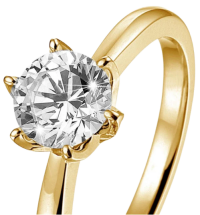
5 Questions to Find Her Perfect Engagement Ring
Are you planning to propose? Finding the right engagement ring is a defining step. Every ring is handcrafted in Antwerp from the finest materials by skilled artisans. Discover what engagement ring fits her personality.
Most viewed diamond jewels
-
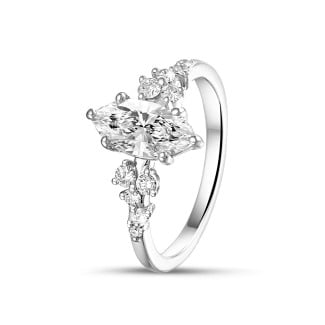
![1.00 carat solitaire cluster ring in white gold with marquise diamond]() BestsellerNew1.00 carat solitaire cluster ring in white gold with marquise diamondFrom USD 4.400,00 (excl. VAT)
BestsellerNew1.00 carat solitaire cluster ring in white gold with marquise diamondFrom USD 4.400,00 (excl. VAT) -
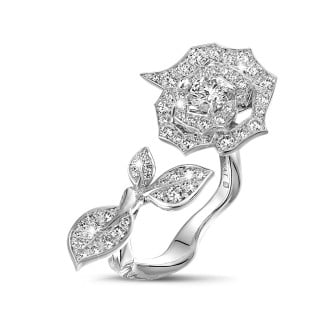
![0.95 carat diamond rose design ring in white gold]() NewPrincess Delphine0.95 carat diamond rose design ring in white goldFrom USD 16.000,00 (excl. VAT)
NewPrincess Delphine0.95 carat diamond rose design ring in white goldFrom USD 16.000,00 (excl. VAT) -
![1.00 carat solitaire ring with an asscher cut diamond in white gold]() Bestseller1.00 carat solitaire ring with an asscher cut diamond in white goldFrom USD 4.700,00 (excl. VAT)
Bestseller1.00 carat solitaire ring with an asscher cut diamond in white goldFrom USD 4.700,00 (excl. VAT) -
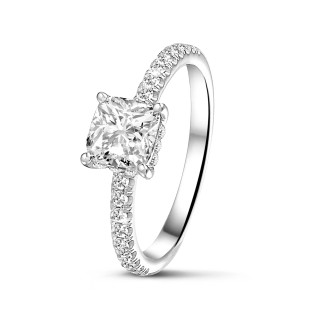
![1.00 carat solitaire ring with a cushion diamond and hidden halo in white gold]() BestsellerNew1.00 carat solitaire ring with a cushion diamond and hidden halo in white goldFrom USD 4.010,00 (excl. VAT)
BestsellerNew1.00 carat solitaire ring with a cushion diamond and hidden halo in white goldFrom USD 4.010,00 (excl. VAT) -
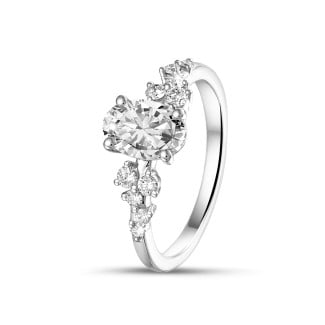
![1.00 carat solitaire cluster ring in white gold with oval diamond]() BestsellerNew1.00 carat solitaire cluster ring in white gold with oval diamondFrom USD 4.590,00 (excl. VAT)
BestsellerNew1.00 carat solitaire cluster ring in white gold with oval diamondFrom USD 4.590,00 (excl. VAT)

.
Why do men get down on one knee to prose?
This tradition is also practical: by kneeling, the proposer often appears less dominant and more vulnerable, which can make the moment feel more intimate and heartfelt. This position of kneeling, historically associated with humility and submission, underscores the proposer’s commitment and sincerity in the gesture.
Interestingly, the tradition of going down on one knee does not originate from the act of proposing marriage. Its roots can be traced back to the times of knights, who would kneel as a sign of respect to their masters or when receiving knighthood. Kneeling was also a common practice in religious ceremonies, symbolising devotion and loyalty — qualities essential in a strong marriage.
The practice of kneeling during proposals likely evolved from these historical customs, adapting the gesture of respect into a romantic context.
Alternatives to kneeling - comfortable, cultural and accessibility-aware options
Kneeling is powerful for many, but it is not the only meaningful posture for a proposal. Here are five concrete alternatives with a short rationale for each.
1. Seated proposal
Rationale: Sit together on a bench, sofa or at a table to create intimacy without physical strain; ideal for mobility limitations or when a quiet, private moment is preferred.
2. Standing and holding hands
Rationale: Face each other, hold hands and speak from the heart; this is simple, mutual and works well when cultural norms discourage a unilateral gesture.
3. A written letter or poem
Rationale: A carefully written text can express thoughts that are hard to speak aloud and can be presented alongside a ring or symbolic item.
4. Family-centred ritual Rationale: Involve parents or close family in a small exchange or blessing; this respects cultural practices where marriage is a family affair.
5. Symbolic exchange (e.g., garland or ritual item) Rationale: Use a culturally relevant symbolic object in place of a ring to honour
traditions such as garlanding or other ceremonial exchanges.
A short note on cultural variation and accessibility
Proposal gestures differ widely across the world; some cultures emphasise exchanges between families, others use ritual objects rather than
How marriage proposals have evolved over time
How the 20th century made kneeling the default: film and advertising
Although kneeling has older symbolic roots in chivalry and liturgy, the idea that a romantic proposal should happen on bended knee largely grew out of twentieth‑century visual culture. Popular images, rather than medieval custom, normalised the kneel as the expected posture for asking someone to marry. Silent cinema, Hollywood staging and commercial advertising together reshaped public expectations, turning a dramatic gesture into a familiar moment of the engagement ritual.
Silent films and early Hollywood offered recurring, easy-to-read images of romance. Directors and cinematographers favoured clear, photogenic actions that an audience could understand at a glance; a man on one knee suggested humility and devotion in a single frame. Cultural historian Paullett Golden has pointed out that film stills and studio publicity from the early 1900s often showed the proposer kneeling, with the ring presented as the scene’s visual climax. Those repeated images helped make the pose look like the natural way to pop the question.
At the same time, print advertising and magazine illustration reinforced the link between the ring and the kneel. Before television became common, illustrated adverts and photo spreads in national magazines circulated idealised moments of courtship. Jewelers and fashion houses used staged photographs, borrowing cinematic composition, to show the moment of offering a ring - frequently with the man kneeling. Seeing that image repeatedly created a strong visual habit: when people pictured a proposal, they often imagined a single dramatic tableau, and the kneel became it.
Mid‑century diamond marketing strengthened that association. Campaigns placed the stone at the centre of an emotional story; presenting a ring during a bowed pose matched those narratives. As those ads spread, they did more than sell jewellery: they suggested a script for modern romance in which ring and kneel went together.
Taken together, silent film, Hollywood staging and twentieth‑century jewelry advertising explain why the kneel now feels natural to many people despite its different historical meanings. The bended‑knee proposal is best seen as a twentieth‑century convention shaped by the visual industries that helped people picture intimate moments. Today’s expectations about getting down on one knee reflect that mediated history: the gesture carries both the older symbolic weight of humility and the cinematic legacy of a staged, photographable instant.
Modern proposals: the rise of creative marriage proposal ideas
However, the practice is evolving. Contemporary proposals often include creative and personalised elements, such as skydiving or bungee jumping, which may not always accommodate the traditional kneeling position.
Early proposals: a business transaction
A significant shift occurred in 1477 when Maximilian of Austria gave his beloved, Mary of Burgundy, a diamond engagement ring. This act marked the beginning of a new tradition, which was initially adopted by the higher classes. However, the diamond engagement ring did not become widely popular until diamonds were discovered in Africa in the 19th century.
Do you put the ring on during the proposal? A simple step-by-step guide
A) Present the ring and wait for "yes" then slip it on (recommended for surprise)
B) Present the ring in the box and keep it there
C) Offer a symbolic token or no ring at all
Dos and don'ts
- Do present the ring in a small box if possible; it keeps focus on the object and protects it.
- Do practise a simple line so the moment feels composed but genuine.
- Do check discreetly for ring size or have a jeweler prepare a temporary sizing solution.
- Don't hide the ring in food, drinks or pranks; those surprises are unsafe and can ruin the moment.
- Don't force an immediate fit if the recipient clearly prefers to try it on later.
- Don't use tension settings or other high-risk mountings as a novelty stunt; safety and durability matter.
Link to practical questions
If you have wondered whether to put the ring on while kneeling, the clearest rule is to follow what will feel most natural and respectful to your partner: present, ask, and if you choose to slip the ring on, do it after hearing "yes." If in doubt, presenting the ring in the box avoids mishaps and keeps the moment focused on the commitment.The perfect marriage proposal with BAUNAT
-
Fabienne Rauw
-
BAUNAT Antwerp
-
-
Fabienne, manager of the German market is able to guide every client with finding the right jewel. She takes care of most of the German orders, but also takes other task on her plate. Thanks to her six years of experience at BAUNAT she acquainted well with the product and the marketing around it. Her degree in PR ensures that BAUNAT is well presented across all media channels. For anyone looking into a new investment opportunity, Fabienne is the perfect guide in this process. No question will be left unanswered, and she will help you every step of the way.
Selected Bespoke Projects
• Eternal Bloom bespoke engagement concept - Role: project lead for client briefing and prototype coordination. Fabienne translated personal design references into a 3D-printed prototype, supervised stone selection and ensured the finished piece matched the client’s vision and comfort preferences.
• Personalized anniversary necklace - Role: design coordinator and quality overseer. She managed the custom design process from the initial sketch to final polishing, liaising between client and workshop to preserve proportions and finish.
• Reimagined heirloom ring restoration and redesign - Role: client consultant and technical coordinator. Fabienne guided the client through options to modernize setting details while keeping sentimental elements, delivering a wearable result that respected the original piece.
Her hands-on involvement in bespoke commissions ensures each custom order has a clear brief, careful prototype review and close follow-up with the workshop, so clients receive a tailored jewel that meets both aesthetic and practical expectations.
Professional enquiries
For speaking engagements, press requests or research collaborations, please send your message to BAUNAT’s communications team with the subject line: "Fabienne Rauw - Professional Enquiry." Include a brief description of the request and any relevant dates or documents. The communications team will route enquiries to Fabienne and provide guidance on next steps.
Fabienne, manager of the German market is able to guide every client with finding the right jewel. She takes care of most of the German orders, but also takes other task on her plate. Thanks to her six years of experience at BAUNAT she acquainted well with the product and the marketing around it. Her degree in PR ensures that BAUNAT is well presented across all media channels. For anyone looking into a new investment opportunity, Fabienne is the perfect guide in this process. No question will be left unanswered, and she will help you every step of the way.
Selected Bespoke Projects
• Eternal Bloom bespoke engagement concept - Role: project lead for client briefing and prototype coordination. Fabienne translated personal design references into a 3D-printed prototype, supervised stone selection and ensured the finished piece matched the client’s vision and comfort preferences.
• Personalized anniversary necklace - Role: design coordinator and quality overseer. She managed the custom design process from the initial sketch to final polishing, liaising between client and workshop to preserve proportions and finish.
• Reimagined heirloom ring restoration and redesign - Role: client consultant and technical coordinator. Fabienne guided the client through options to modernize setting details while keeping sentimental elements, delivering a wearable result that respected the original piece.
Her hands-on involvement in bespoke commissions ensures each custom order has a clear brief, careful prototype review and close follow-up with the workshop, so clients receive a tailored jewel that meets both aesthetic and practical expectations.
Professional enquiries
For speaking engagements, press requests or research collaborations, please send your message to BAUNAT’s communications team with the subject line: "Fabienne Rauw - Professional Enquiry." Include a brief description of the request and any relevant dates or documents. The communications team will route enquiries to Fabienne and provide guidance on next steps.