







Features:
-
Category:
-
Posted at:
-
Author:
- Sofie Kuppens
-
BAUNAT Antwerp
-


-
Reading time:10 minutes
In this article:
- How materials affect engagement ring prices
- The impact of materials fineness and alloys on price and quality
- The most important factor determining the price: the engagement ring gemstone
- Understanding diamond pricing: the 4C’s
- How to get the biggest-looking diamond for your budget
- How expensive should an engagement ring be?
What determines the price of an engagement ring
Buying a ring for an engagement is a meaningful investment in one of the most beautiful moments in a couple's life, but finding the right balance between sentiment and cost is important. The price of an engagement ring varies widely, ranging from a few hundred euros to six or even seven figures, depending on several factors. In this guide, we'll explain how these prices are determined.
Read summary
What factors determine the price of an engagement ring?
Wondering what drives the cost of that special ring for your proposal? The price of an engagement ring can range from hundreds to millions of euros, with several key factors determining its value.
The metal used forms the foundation of the price—platinum costs more than gold, which costs more than silver. The metal's fineness (purity) also influences cost, with higher percentages of precious metal commanding higher prices.
However, the gemstone contributes the majority of an engagement ring's value. For diamonds, pricing follows the 4C's: carat (size), color (whiteness), clarity (lack of flaws), and cut (proportions). You can save significantly by choosing diamonds that appear perfect to the naked eye rather than technically flawless stones.
Where you purchase matters too—online retailers like BAUNAT typically offer better value than luxury brands with expensive storefronts. The European average spend is approximately €2,500.

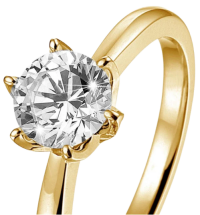
5 Questions to Find Her Perfect Engagement Ring
Are you planning to propose? Finding the right engagement ring is a defining step. Every ring is handcrafted in Antwerp from the finest materials by skilled artisans. Discover what engagement ring fits her personality.
Most viewed diamond jewels
-
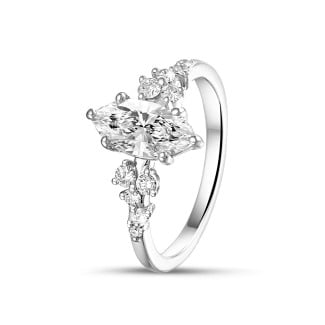
![1.00 carat solitaire cluster ring in white gold with marquise diamond]() BestsellerNew1.00 carat solitaire cluster ring in white gold with marquise diamondFrom USD 4.400,00 (excl. VAT)
BestsellerNew1.00 carat solitaire cluster ring in white gold with marquise diamondFrom USD 4.400,00 (excl. VAT) -
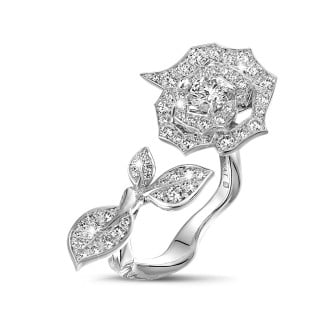
![0.95 carat diamond rose design ring in white gold]() NewPrincess Delphine0.95 carat diamond rose design ring in white goldFrom USD 16.000,00 (excl. VAT)
NewPrincess Delphine0.95 carat diamond rose design ring in white goldFrom USD 16.000,00 (excl. VAT) -
![1.00 carat solitaire ring with an asscher cut diamond in white gold]() Bestseller1.00 carat solitaire ring with an asscher cut diamond in white goldFrom USD 4.700,00 (excl. VAT)
Bestseller1.00 carat solitaire ring with an asscher cut diamond in white goldFrom USD 4.700,00 (excl. VAT) -
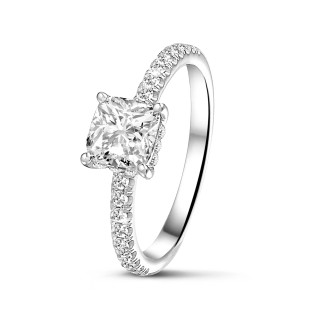
![1.00 carat solitaire ring with a cushion diamond and hidden halo in white gold]() BestsellerNew1.00 carat solitaire ring with a cushion diamond and hidden halo in white goldFrom USD 4.010,00 (excl. VAT)
BestsellerNew1.00 carat solitaire ring with a cushion diamond and hidden halo in white goldFrom USD 4.010,00 (excl. VAT) -
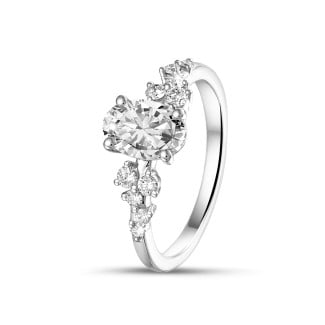
![1.00 carat solitaire cluster ring in white gold with oval diamond]() BestsellerNew1.00 carat solitaire cluster ring in white gold with oval diamondFrom USD 4.590,00 (excl. VAT)
BestsellerNew1.00 carat solitaire cluster ring in white gold with oval diamondFrom USD 4.590,00 (excl. VAT)

How materials affect engagement ring prices
The impact of materials fineness and alloys on price and quality
Fineness
- Definition: fineness measures the purity of a precious metal.
- Scale: it is stated in thousandths (e.g., 750 means 75% pure gold).
- Impact on price: higher fineness means a higher price due to more precious metal content, so fine engagement rings are generally more expensive
Alloys
- Definition: an alloy is a mixture of a precious metal with other metals.
- Examples:
- 333 gold: contains one-third pure gold and two-thirds other base metals. It is considered an inferior alloy.
- 750 gold: contains three-quarters pure gold and one-quarter other metals, making it a high-quality alloy.
Other metals are added to influence the colour, e.g. to obtain red gold or white gold, but also to increase the stability. Pure 999 gold would be too soft to make jewellery, like an engagement ring, for example.
The more precious and scarce the metal, and the more of this precious metal is used, the higher the price of the engagement ring. A wide platinum engagement ring costs more than a delicate engagement ring in gold, which in turn has a higher price than a silver ring.
You can save on the material, but at the expense of the resale value and often also the durability of the ring. An investment in a valuable precious metal pays off and ensures that you will enjoy your engagement ring for a lifetime. The price of the chosen precious metal usually only makes up a small part of the total price, because the main value in an engagement ring is determined according to the gemstone used.
The most important factor determining the price: the engagement ring gemstone
Understanding diamond pricing: the 4C’s
- Carat: the larger the diamond, the more expensive it is
- Colour: the whiter the diamond, the higher its price
- Clarity: the fewer the flaws, the more valuable the diamond
- Cut: the better the cut and proportions, the more costly the diamond
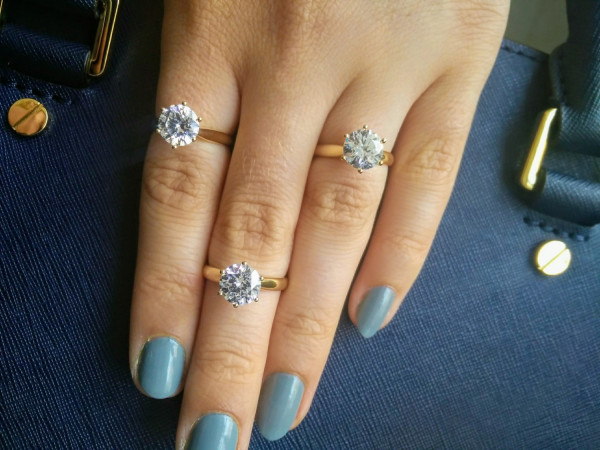
You can save cleverly by opting for diamonds that appear perfect to the naked eye. In everyday life, a diamond with colour G/H, clarity SI1/VS2, and a Very Good cut can look just as impressive as a more expensive stone with colour D/E, flawless clarity (IF or FL), and an excellent cut. Only a professional can tell the difference upon close inspection.
How to determine the cost of an engagement ring
The easiest way to answer the question "How much does an engagement ring cost?" is by looking at the price of the diamond(s). A solitaire engagement ring with a larger stone of particularly good quality will quickly become expensive. An alternative would be a trilogy engagement ring, for example, as the price for 3 smaller diamonds with a total weight of 1 carat is less than that of one single diamond of 3 carats.Where you buy matters
It is also important where you buy the engagement ring. World-famous brands with a large number of expensive shops in inner-city locations usually have higher prices. In contrast, digital native companies like BAUNAT, which focus on E-commerce and source diamonds directly, offer more competitive pricing.How to get the biggest-looking diamond for your budget
Choosing a diamond with strategy usually gives more visual impact than simply chasing carat weight. Thoughtful trade-offs - prioritising cut, using just-under carat thresholds, picking certain shapes and choosing the right setting - let you maximise the perceived size and brilliance of the centre stone while keeping costs sensible.Prioritise cut over carat
- Why cut matters: cut quality determines how well a diamond returns light. An excellent cut makes a stone look brighter and more lively than a larger, poorly cut diamond. Aim for Ideal or Very Good cuts for brilliant shapes; these grades keep sparkle high without the steep premium of the very top proportions.
- Practical tip: compare two stones side by side in similar light. A smaller, better-cut diamond will often read as larger on the finger because of superior brightness and contrast.
Just-under carat trick
- Price behaviour: diamonds commonly jump in price at round carat benchmarks. Choosing a stone just under a major benchmark (for example 0.95–0.99 ct instead of 1.00 ct) can save a noticeable amount while delivering almost the same visual presence.
- How to apply it: set your search filters to include the fractional range below the next full carat. Retail listings often group stones by whole-carat buckets, so you get more value by targeting the high end of the lower bucket.
Balanced colour and clarity choices
- Colour: for most viewers the sweet spot sits in the near-colourless range. Choosing G to H balances whiteness and value, producing a stone that looks white in most settings without the premium of top-tier colour grades.
- Clarity: selecting VS2 to SI1 offers a good compromise between eye-clean appearance and cost. Many SI1 stones are eye-clean once set, especially with brighter cuts. Avoid recommending clarity grades below SI1 as a general preference.
Choose shapes that maximise perceived size
- Elongated and fancy shapes such as oval, marquise and emerald spread carat weight across a longer surface, making the stone appear larger than a round of the same carat weight. Pear and marquise cuts in particular add perceived length on the finger.
- Note on proportions: for elongated cuts, choose balanced length-to-width ratios to avoid an overly narrow look; an experienced jeweller can advise on suitable proportions for each shape.
Setting tactics to enhance apparent size and brilliance
- Halo settings: a halo of smaller stones around the centre increases apparent diameter and sparkle, making the centre stone look larger without adding carat weight.
- Pavé and micro-pavé: accent stones along the band add continuous brightness, drawing the eye and enhancing perceived size.
- Bezel vs prong: prong settings expose more surface area of the centre stone, often making it look bigger than a full bezel, which can reduce apparent size.
Two example scenarios
- Example A (value-for-brilliance): a well-cut 0.90 ct VS2 G oval set in a halo will look notably large on the hand thanks to the elongated shape and halo amplification, offering strong sparkle and perceived size for a restrained budget.
- Example B (carat-first solitaire trade-off): a 1.00 ct SI1 I round solitaire offers the psychological appeal of a full-carat stone and a classic silhouette, but compared with Example A it may appear less bright and slightly smaller in perceived diameter if the cut is not top grade.
Quick checklist before you buy
- Prioritise cut grade (Ideal or Very Good) for brilliance.
- Search just under whole-carat thresholds to find value bargains.
- Target colour G–H and clarity VS2–SI1 for a balance of appearance and price.
- Consider elongated shapes and halo/pavé settings to maximise perceived size.
- Compare stones in similar light and, when possible, view the setting to understand how the stone sits on the finger
Using these tactics consistently helps you achieve the largest-looking, brightest centre stone for your budget without sacrificing long-term satisfaction.
How expensive should an engagement ring be?
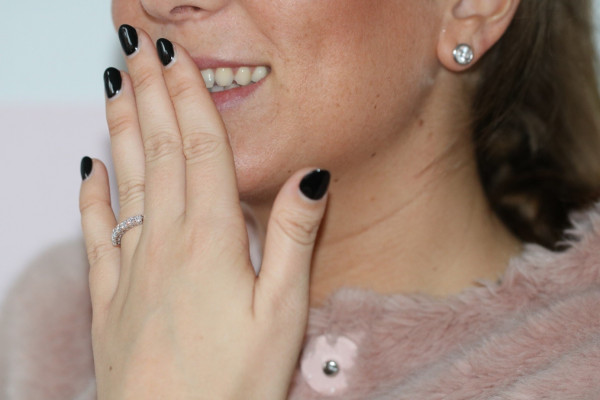
How much your engagement ring may cost is up to you to decide. You should neither go into debt nor be miserly with probably the most important ring that a woman will ever have put on her finger. In contrast to consumer goods, the investment in an engagement ring is always an investment of lasting value, and a beautiful one in particular.
-
Sofie Kuppens
-
BAUNAT Antwerp
-
-
“Logistics Champion”, which is the title Sofie was awarded with in 2018, leads and supervises the processing of orders and logistics and closely working together with the BAUNAT order team. She strives to ensure maximum customer satisfaction by keeping our clients up to date in the production process and delivering on-time. To improve her product expertise even further, Sofie completed the Diamond Foundation Course by De Beers, which makes her a true diamond specialist.
Professional experience
BAUNAT Group N.V. - Logistics Champion & Order Team Lead (2016–present)
Sofie supervises processing of bespoke orders and coordinates logistics between production and customer service. She keeps clients informed during production, improves internal workflows to reduce variability in lead times, and helped introduce quality checkpoints that raised order accuracy and client satisfaction.
Customer Service & Production Coordinator, BAUNAT Antwerp (2012–2016)
Coordinated daily activity between ateliers and the orders desk, trained new staff to handle custom requests, and developed procedures for order tracking and client communication that strengthened after‑sales follow‑up.
Retail Sales Advisor, Fine Jewellery Boutique (2009–2012)
Advised clients on high‑end jewellery purchases, gained hands‑on experience with diamond grading basics, and refined consultation skills that inform her current role in bespoke order management.
Diamond Foundation Course, De Beers - Certified Graduate (2020)
Completed professional training in diamond properties and grading to deepen gemstone knowledge used in quality checks and client consultations.
Education & credentials
AP Hogeschool Antwerpen - Degree in Applied Business Management, marketing track. De Beers Diamond Foundation Course - Certified Graduate, 2020. Ongoing in‑house BAUNAT training in bespoke jewellery processes and customer experience.
Selected publications & courses
Diamond Foundation Course, De Beers, provider certification and practical grading sessions. BAUNAT blog articles by Sofie Kuppens on engagement ring selection, diamond care and jewellery trends, published on the BAUNAT site between 2023 and 2025. Internal BAUNAT workshops on order logistics and client communication.
Recent activity & perspectives
Unveiling the importance of Engagement Ring Insurance in the UK - "Insuring an engagement ring is not only about protection, it is about securing the emotional and financial value of a lifelong symbol." (12-07-2024, Gemstones)
Unlocking the Meaning Behind Your Engagement Ring's Gemstone - "A gemstone can carry sentiment and story; choosing the right stone means balancing personal meaning with lasting quality." (11-07-2024, Jewellery)
Mastering the Art of Wearing Asymmetrical Earrings - "Asymmetry offers a contemporary silhouette that allows each ear to tell part of a single, stylish story; the key is proportional balance." (04-07-2024, Earrings)
Choosing the right carat weight for your diamond earrings - "Visual impact depends on setting and cut as much as on carat weight; thoughtful design can maximise perceived sparkle without unnecessary size." (11-09-2024, Jewellery)
“Logistics Champion”, which is the title Sofie was awarded with in 2018, leads and supervises the processing of orders and logistics and closely working together with the BAUNAT order team. She strives to ensure maximum customer satisfaction by keeping our clients up to date in the production process and delivering on-time. To improve her product expertise even further, Sofie completed the Diamond Foundation Course by De Beers, which makes her a true diamond specialist.
Professional experience
BAUNAT Group N.V. - Logistics Champion & Order Team Lead (2016–present)
Sofie supervises processing of bespoke orders and coordinates logistics between production and customer service. She keeps clients informed during production, improves internal workflows to reduce variability in lead times, and helped introduce quality checkpoints that raised order accuracy and client satisfaction.
Customer Service & Production Coordinator, BAUNAT Antwerp (2012–2016)
Coordinated daily activity between ateliers and the orders desk, trained new staff to handle custom requests, and developed procedures for order tracking and client communication that strengthened after‑sales follow‑up.
Retail Sales Advisor, Fine Jewellery Boutique (2009–2012)
Advised clients on high‑end jewellery purchases, gained hands‑on experience with diamond grading basics, and refined consultation skills that inform her current role in bespoke order management.
Diamond Foundation Course, De Beers - Certified Graduate (2020)
Completed professional training in diamond properties and grading to deepen gemstone knowledge used in quality checks and client consultations.
Education & credentials
AP Hogeschool Antwerpen - Degree in Applied Business Management, marketing track. De Beers Diamond Foundation Course - Certified Graduate, 2020. Ongoing in‑house BAUNAT training in bespoke jewellery processes and customer experience.
Selected publications & courses
Diamond Foundation Course, De Beers, provider certification and practical grading sessions. BAUNAT blog articles by Sofie Kuppens on engagement ring selection, diamond care and jewellery trends, published on the BAUNAT site between 2023 and 2025. Internal BAUNAT workshops on order logistics and client communication.
Recent activity & perspectives
Unveiling the importance of Engagement Ring Insurance in the UK - "Insuring an engagement ring is not only about protection, it is about securing the emotional and financial value of a lifelong symbol." (12-07-2024, Gemstones)
Unlocking the Meaning Behind Your Engagement Ring's Gemstone - "A gemstone can carry sentiment and story; choosing the right stone means balancing personal meaning with lasting quality." (11-07-2024, Jewellery)
Mastering the Art of Wearing Asymmetrical Earrings - "Asymmetry offers a contemporary silhouette that allows each ear to tell part of a single, stylish story; the key is proportional balance." (04-07-2024, Earrings)
Choosing the right carat weight for your diamond earrings - "Visual impact depends on setting and cut as much as on carat weight; thoughtful design can maximise perceived sparkle without unnecessary size." (11-09-2024, Jewellery)